Friday Recap October 17th, 2025


My Comment
Election integrity is fundamental to our republic. If we can't trust our elections, then we don't really have a republic at all. I am not a fan of voting machines and would like to see us return to hand-marked, paper ballots. I do think that Williamson County Elections are secure. However, we, like all counties who use machines, are susceptible to being hacked. Frank Limpus has written an article in the Tennessee Conservative that outlines the latest issue with machines. You can read it here Out Dated Election Machine Software
BOMA Election
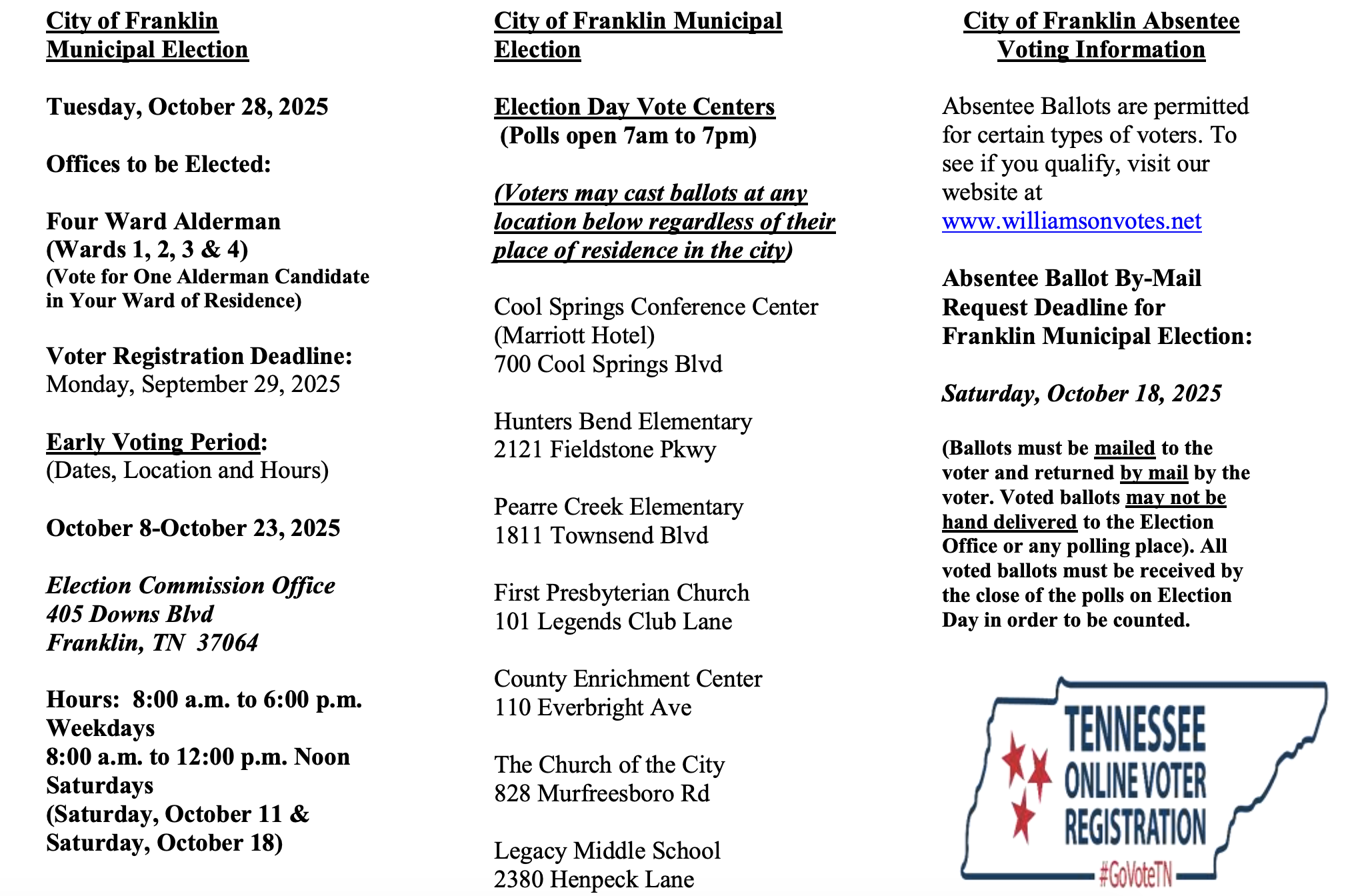
Early voting ends on the 23rd and election day is the 28th. All four wards are up this cycle, but only 2 and 4 have more than one candidate.
Matt Brown is the incumbent in Ward 2 and his challengers are Errin Watkins and BK Muvvala. Patrick Baggett is the incumbent in Ward 4 and his challenger is Rodney Taylor. The Williamson County Republican Party held a forum to which all but Matt Brown attended; to watch it go to Forum to hear what the candidates have to say.
WCRP Mix and Mingle, October 23rd
The WCRP will be holding their monthly mix and mingle on Thursday, October 23rd. The guest speaker will be Matt Van Epps, who is the Republican candidate for the U.S. Representative 7th District in Tennessee. We all need to get behind Van Epps as this is not a laydown election. The Democrats are well organized and energized. As I mentioned last week, the vote differential between Republicans and Democrats in the recent primary was only 18%, 36,854 Republicans to 31,002 Democrats for a difference of only 5,852 votes. For full details go here: WCRP Mix and Mingle.
Guitars for Vets
Guitars for vets is a great organization. We give veterans 10 free, one-hour guitar lessons and, upon completion, they receive a brand-new guitar, gig bag, a turner, capo and stand. It is a great program and you can learn more at G4V.
This Saturday, the 18th, graduates will be playing at a music showcase at the Franklin VFW. If you're looking for something to do, come on out and join in on our sing alongs.

Special note on the school budget
Since the school budget is over 70% of our total county budget, any reduction in their capital plan is welcome news. At the Thursday Work Session, they were presented with the following:
- Board will vote in November 2025 on 5-year capital improvement plan totaling $44,635,000 for FY2026, down from $143,325,000 proposed last year.
- Enjoying Friday Recap? Take a minute now and forward it to 3 people. Copy this https://friday-recap.ghost.io/ghost/#/editor/post/680aad97ab206e0001e15b3f in your email.
The AI program I use is pretty accurate, but it does make mistakes from time to time and I don't always catch them. I provide agendas and videos/audios when I have them available and recommend that you watch the video and follow along with the summary to get the most accurate report.
One of the limitations of AI is that if a participant's name is not called out, then they are listed as participant 1, 2, etc. A limitation with audio, as opposed to video, is that one cannot always identify a person by voice alone. As imperfect as these AI summaries are, they still give a pretty good account of a meeting.
Williamson County School District
Thursday October 16th
School Board Work Session Agenda Video
AI Summary
Action Items
- [ ] Jason Golden - Provide data on out-of-zone students by high school Send data to board members before the November voting meeting showing which high schools are receiving the most out-of-zone students and from which schools they are being pulled.
- [ ] Ken Brown - Put school start times discussion on agenda for board vote Add the school start times discussion to the agenda for a board vote on whether to direct staff to proceed with additional analysis and planning, or to discontinue the initiative.
- [ ] Jason Golden - Send longitudinal private school enrollment data Once reports are received from private schools about students with WCS addresses enrolled there, provide board members with longitudinal information comparing this year's data to last year's data.
- [ ] Brian King - Create color-coded map showing school capacity percentages by zone Create a visual map with school zones color-coded by occupancy rate (e.g., over 90% in red, 80-90% in yellow, below 80% in green) to show which spots have vacancies and which are at capacity, to present to the county commission.
- [ ] Jason Golden - Research policy requirements for implementing multi-year superintendent goals Research and present at the next work session what would be needed to implement multi-year superintendent goals, including any contract amendments and policy updates that would be required.
- [ ] Jen Sauer - Provide list of materials that passed state textbook vetting As soon as the State Board of Education posts their agenda with the Textbook Commission's recommended selections for health, PE, and CTE courses, make the list available to board members and provide a link to the state board agenda.
- [ ] Brian King - Post the draft capital improvement plan PowerPoint online Post the capital improvement plan PowerPoint presentation online so that board members can access and click on the state website links for materials submitted for vetting.
Overview
- Committee completed comprehensive analysis of ACT performance showing Williamson County had both highest projected achievement and highest growth in Tennessee—achieving a growth index of 15, which is several standard deviations above expected performance
- Board will vote in November 2025 on 5-year capital improvement plan totaling $44,635,000 for FY2026, down from $143,325,000 proposed last year
- All high school principals unanimously recommended not implementing mid-year changes to cell phone policy, specifically opposing removing lunch phone access before fall 2026
- Board discussed implementing bell-to-bell cell phone restriction starting January 2026 versus waiting until August 2026, with concerns about enforcement infrastructure and parent communication access
- Textbook adoption process on track with State Board approval expected September 21, 2025 and 6 public review sessions scheduled from January 2026 through February 2026
- District enrollment declined 0.9% this year with elementary grades showing most significant decreases, prompting delays in new school construction timelines by 2 years for several projects
- School nurses handled 25,000 visits in September 2025 alone, with 92% of students returning to class rather than going home
Consent agenda items
- Three items scheduled for November 2025 meeting approval: September board minutes, policy 3.202 emergency preparedness plan for second reading, and field trip fee requests
ACT performance and growth analysis
- State analysis projected Williamson County 8th graders would be highest performing in Tennessee and they exceeded those projections with highest growth from 8th grade to senior year
- District achieved growth index of 15, representing several standard deviations above the zero baseline that indicates expected growth
- Performance demonstrates impact of K-12 instruction, with Franklin Special District 8th graders also contributing to results since some attended Franklin Special for middle school
- Each additional ACT point translates to scholarship dollars and better college placement for students
- District focusing this year on students with unique learning needs to ensure individual student growth beyond just averages
Textbook adoption process update
- Adopting materials for health and PE in grades 6-12 and career and technical education courses—no adoption needed for K-5 health since standards are minimal and embedded
- Middle school health adoption is local process (not state vetted) since state didn't request materials, but teachers want updated resources for the 9-week combined health/PE course
- High school lifetime wellness is full-year graduation requirement covering approximately 20% health content and 80% physical fitness
- Publishers included supplemental family life materials, but district not adopting those—will continue using existing family life curriculum and presentation
- State vetting process happening now with Textbook Commission recommendations going to State Board for approval on September 21, 2025
- Teachers will receive full curriculum but students won't have individual access—teachers will pull aligned lessons for instruction only
- District reached out to same publishers submitting high school materials to get middle school resources for local review
- CTE courses being adopted include information technology, advanced manufacturing, and primarily engineering electives not taught at every high school
- 6 public review sessions scheduled in January and February 2026 with mix of daytime and evening times to accommodate various schedules
- Review materials will be available at selected schools and digitally on website with online feedback form
- First textbook committee meeting set for November 3, 2025 (half day) to establish criteria checklists before materials arrive
- Second committee meeting on December 8, 2025 for timeline review and oath administration
- Publisher presentations scheduled for either January 20, 2026 or January 22, 2026 (to be confirmed)
- Teachers will submit preference forms with written explanations for their choices as new requirement this year
Draft capital improvement plan
- Intent to fund request for FY2026 is $44.635M, reduced from $140M shown in last year's projection
- Five-year total reduced from over $800M to approximately $600M compared to last year
- Plan required by law to assess privilege taxes (development taxes) on new construction and helps county bond rating
- New school construction timelines pushed back due to 0.9% enrollment decline this year and elementary enrollment decreases
- Split Log middle school moved from fall 2027 opening to fall 2029
- Northeast McFarland Road elementary moved from 2028 to 2030 opening
- Spring Station Middle requesting startup money for new auditorium—only middle school without true auditorium, currently has permanent seating for 116 in cafeteria space
- Major renovations focus on schools 30 years or older, including Grassland Middle (built 1986) for ceiling tiles, painting, floors, asbestos remediation, and front entrance security work
- Nolensville High School addition planned for 22 classrooms to address 95% capacity (up from 89% last year)
- Phase three of access control and intercom alert systems will complete installation at all schools if funded
- Athletic field lighting replacement requested for high school ballast-type lights that require bulb replacement twice yearly
- Fairview area elementary school projected for fall 2030, with district exploring land purchase options from developers to potentially retire old Fairview Elementary building (district's oldest) and build new facility
- Current high school capacity percentages: Brentwood 77%, Centennial 74%, Fairview 65%, Franklin 84%, Page 77%
- Centennial High School 22-classroom addition pushed back one year based on enrollment projections
- June Lake development in Spring Hill has 20-year buildout schedule with homes starting around $800,000
- Board will vote on plan at November 2025 meeting, with county commission also required to approve
School start times discussion
- Committee completed analysis showing net positive impact for secondary schools with later start times, with only negative being extracurriculars
- Elementary schools showed negative outcomes for attendance, behavior, and extracurriculars with earlier start times in research studies
- Secondary students get more sleep with later start times—no contradicting evidence in research
- Teenage driving accidents decreased in multiple studies when secondary start times moved later, including significant data from Cherry Creek district
- One Kentucky study of 310,000 elementary students found earlier start times associated with greater behavior problems including harassment, suspensions, and expulsions
- Proposal would flip start times so elementary starts first and secondary second, not just adjust by 10-15 minutes
- Next steps if board approves would involve principals, athletic directors, coaches, and assistant superintendents analyzing extracurricular scheduling with current facilities (no additional capital)
- Most middle schools lack adequate night lighting for athletic fields
- Committee recommended no changes this school year, but some board members want to proceed with additional planning
- Board discussed whether to vote on moving forward with detailed implementation planning or drop the initiative entirely
- Multiple board members opposed moving forward, citing concerns about family dinner time, homework start times, enforcement during lunch, and need for additional capital for field lighting
- Private schools allowing students to email parents from school accounts cited as different situation than Williamson County where students lack that communication access
- Cherry Creek district studied with 24,000 students showed decreased before-school activity participation but stable after-school participation with earlier elementary start times
Construction updates
- Brentwood Middle School building complete, working on final outdoor phase scheduled for November 2025 completion
- Multi-purpose field topsoil and irrigation complete at Brentwood Middle, sodding planned for last week of October 2025
- Innovation Center roof installation complete, landscaping begun, windows complete, most drywall complete
- Flooring and kitchen equipment installation beginning next week at Innovation Center for culinary arts program
School nurses monthly statistics
- 25,000 visits to school nurses in September 2025
- Nearly 6,000 visits were scheduled (medications, feedings, doctor-ordered procedures)
- 92% of students who visited nurse returned to classroom rather than going home
- Results demonstrate nurses' effectiveness at keeping students in school and learning without disruption
2025-26 school board budget items
- Transportation reimbursement grant approved for $136,618 to offset bus driver pay expenses
- Bus purchase request totals $3,184,000 using fund balance for 8 replacement general ed buses, 7 replacement special ed buses, and 4 growth special ed buses
- District retiring 14 general ed buses but only replacing 8 to reduce fleet size toward 20% sub bus target
- Special ed ridership continues growing despite flat overall enrollment
- Replacing smaller 12-passenger special ed buses with larger 22-passenger buses to reduce routes and future costs
- Salary adjustment entry of $12,465,616 to move 2% raises, additional supplements, and additional staff days from single line item into individual budget lines (no cost, just accounting correction)
Board policies for first reading - textbooks and instructional materials
- Policy 4.401 revised to require teacher preference forms include written explanations for textbook choices
- Added requirement for presentation to board about textbook adoption process and committee recommendations
- Clarified that all board members may serve as ex officio (non-voting) members of textbook committee and attend meetings
- Board members serving as ex officio can participate in dialogue and ask questions during committee meetings
- Language clarified to distinguish between ex officio status and non-voting participation per Robert's Rules
- Committee will continue using identified teacher preference forms (not anonymous) to allow school representatives to see which grade levels prefer which materials
- Board members raised question of whether to take same oath as textbook committee members to confirm commitment and prevent inappropriate publisher influence
Wireless communication devices policy
- Extensive rewrite of policy 6.312 incorporating technology committee recommendations plus additional bell-to-bell restriction
- Committee unanimously recommended no policy changes this school year based on successful implementation so far
- All high school principals unanimously said no to more restrictive mid-year policy changes when specifically asked
- Proposed changes include: defining "silenced" as off the body, firmer Smart Watch language, specific consequences by grade level, clearer definition of educational purposes for middle school exceptions, and maintaining high school lunch phone access
- Alternative proposal from board member removes lunch phone access, implementing full bell-to-bell phone restriction starting January 2026
- Concerns raised about enforcement during lunch with current supervision structure, lack of parent-to-student email communication system, and compressed timeline with only 5 weeks of instruction between November 17th start date and winter break
- 18 states now have full away-for-day phone bans during school day
- Warren County Tennessee superintendent reported 700 fewer disciplinary referrals in first year of away-for-day policy
- Research shows students need up to 20 minutes to refocus after checking phone, with 25-minute lunch periods meaning little time to refocus afterward
- Current policy shows strong compliance during instructional time with students putting phones away when asked during transitions
- Teachers and administrators using first semester to educate students on policy before implementing consistent consequences in second semester
- High school lunch observations showed approximately 10% of students on phones with most engaged in conversation with peers
- Students currently pick up phones from classroom storage containers during transition between classes, using them for approximately 5 minutes per hour during transitions
- Private schools cited (Harpeth Hall, Curry Ingram, Christ Presbyterian Academy) allow students to email parents from school accounts, which Williamson County doesn't offer
- Proposed solutions include: creating parent-to-student email system, establishing cell phone zones for necessary use, implementing pouch systems for storage
- Board divided on timeline with some supporting January 2026 implementation and others preferring August 2026 to allow time for infrastructure and communication solutions
- Policy will come to November 17, 2025 voting meeting for decision on moving to second reading
Textbook committee approval
- Board approving recommended textbook committee members for health/PE and CTE adoptions
- Committee expanded from original 7 parent members to 12 parent members based on board recommendations
- Names finalized approximately one week before board packet released during fall break
2025-26 superintendent and district goals
- Four proposed goals with specific deliverables based on September 2025 work session discussion
- Some goals anticipated to become ongoing multi-year initiatives requiring next steps in future years
- Goals include: professional salary study recommendations, opportunities for innovative instructional models, proactive stakeholder engagement, and continued safety/security improvements
- Board member proposed alternative SMART goals framework including: unified district data dashboard, 5% overall growth in reading/math with 7% growth for underperforming subgroups, family/staff/community engagement with advisory groups and parent survey, and fiscal accountability through operational efficiency study
- Discussion acknowledged timing challenge with goals set in November but school year starting in August, making academic achievement goals difficult to measure
- Superintendent contract requires annual goals beyond state evaluation requirements
- 85.4% of district budget is staff-related expenses, requiring careful targeting of any cost reduction goals
- Strategic plan has specific objectives with action steps, while superintendent goals traditionally focus on current-year priorities outside strategic plan
- Board considering multi-year goals aligned to strategic plan rather than annual goals, which would require contract amendment
- Parent survey proposed as valuable data source since district surveys teachers and students but not parents consistently
- Data dashboard discussion noted significant budget and staffing requirements, with Metro Nashville spending tens of millions to build their system
- Board will vote on four proposed goals at November 2025 meeting with potential future discussion of goal-setting process changes
Board goals informing strategic plan
- Two proposed board goals: supporting superintendent goal on community and corporate partnerships, and increasing board member involvement at schools through visits and participation
- First time in years board voting on specific board goals rather than just focusing on superintendent goals
- Board will vote on goals at November 2025 meeting
Monday October 20th
School Board will meet at 6:30 PM in the Auditorium at the Williamson County Administrative Building located on the first floor at 1320 West Main Street, Franklin. Agenda Video
Williamson County Commission
Monday October 13th
The Steering Committee. It was a very short meeting. Per county rules, Brian Beathard, because he is chairman, can't be on the Tax Study committee. The Rules committee voted Drew Torres to take his place.
County Commission Agenda/Packet Convention Center Presentstio
AI Summary
Overview
- Conference center operating agreement extended to October 14, 2032 after two amendments—original request was for 2037, first amendment reduced to 2035, final amendment set 2032 (passed 14-8)
- County approved bond issuances totaling approximately $66.3 million for capital projects ($32.8M for school projects, $33.5M for county improvements including fire equipment and facilities)
- Commission passed resolution requiring recording and archiving of all committee meetings starting January 1, 2026 to improve transparency (20-1-1) Commissioner Tunnicliffe noted no and commissioner Webb abstained
- County deployed mobile command trailer, radio communications equipment, and 11 personnel to assist Hickman and Humphreys counties following AES explosion that killed 16 people
- Insurance changes will save county $1.3 million on retiree Medicare supplement plan and projected $8 million annually from eliminating weight loss drug coverage
- Tourism generated $1.3 billion in visitor spending during 2024, up 3% from prior year, creating $153,000 per day in local tax revenue
Traffic safety concerns at Bethesda Rec Center
- Cindy Walton from Thompson Station raised safety concerns about accessing her mailbox across from the rec center
- Traffic increased significantly since rec center opened, with vehicles traveling 45-55+ mph on road with limited sight lines due to two hills and curve
- Walton's family has lived at location since 1986 and mailboxes are on opposite side of road per USPS requirements
- She contacted county commissioners, Marsha Blackburn's office, and USPS but no solution has been implemented
- Phase two of rec center will increase traffic further
- Walton requested speed bumps, reduced speed limits, or increased traffic enforcement
Conference center operating agreement extension
- Chartwell Hospitality requested 10-year extension (to 2037) of conference center management agreement, citing lender requirements for refinancing
- Conference center has netted $4.8 million profit over 26 full fiscal years for county's portion (city gets equal share)
- Last four years averaged $373,000 annual profit for county
- Tax contribution in 2024 was $1.24 million for county
- Conference center currently has $877,000 in function revenue booked beyond current agreement termination date of October 2027
- Conference center was closed entire month of August for renovation costing approximately $2.8 million (mostly federal funds), resulting in $131,000 loss that month
- Hotel receiving separate $6.5 million renovation starting end of month, completing early May
- Chartwell operates seven hotels in Williamson County generating over $4 million in annual tax revenue
- Commission amended extension twice: first to 2035 (passed 14-8), then to 2032 (passed 14-8)
- Final resolution as amended to 2032 passed 14-8
- Several commissioners expressed concern about government's role in hospitality business and contract length
- Lenders require longer terms because current 5-year loan would mature with only 2 years remaining on management agreement
Hospital strategic planning RFP process
- Williamson Health Board engaged in comprehensive strategic planning process exploring all pathways including remaining independent or potential ownership change
- RFP made available to vetted qualified organizations nationwide, managed by Kauffman Hall
- First round of responses expected before end of 2025
- Next update likely sometime in 2026
- Board aware of unauthorized online and phone survey circulating about strategic planning—survey not from Williamson Health
- All interested parties agreed to communicate only with Kauffman Hall representatives per RFP stipulations
- Any attempts to contact commissioners, elected officials, media, community members, or hospital staff outside agreed boundaries will be considered during evaluation
- Hospital pursuing avenues to remain independent with equal vigor alongside RFP process
- Mayor Anderson received Trustee of the Year award from Tennessee Hospital Association in September for 30 years of healthcare service
Tourism economic impact results
- Total visitor spending in Williamson County reached $1.3 billion in 2024, up 3% from prior year
- Visitors spend $3.7 million per day in county
- Daily visitor spending generated $153,000 per day in local tax collections (not including state portion)
- Tourism saves $1,631 per household annually for Williamson County residents
- Visit Franklin recognized as Large DMO of the Year by Tennessee Hospitality and Tourism Association
- Organization updated branding to emphasize serving entire county with eight unique communities
Mutual aid response to AES explosion
- AES facility explosion in Humphreys and Hickman counties killed 16 people
- Williamson County deployed 11 personnel including Public Safety Director Connor Scott
- County provided mobile command trailer serving as law enforcement and ATF command post
- Radio communications trailer deployed to establish communications in area with poor cell and radio reception
- ATF using county's radio tower for their communications
- Two county ATVs deployed to navigate 1,300-acre complex
- Sheriff's office helicopter may provide aerial reconnaissance
- Personnel assisting with planning, logistics, strategic conversations, and gate check-in operations
- AES facility manufactures explosives with major contracts including US Military
- Investigation into cause may take months and exact cause may never be determined
- Building where explosion occurred completely leveled
Committee meeting recording requirements
- Resolution passed requiring recording and archiving of all committee meetings starting January 1, 2026
- Recordings will be hosted online for public access
- Over 2,500 people viewed budget meeting streams since recording began
- Current budget committee recording method adequate but could be improved with additional microphones
- Executive conference room and auditorium both available for recorded committee meetings
- Franklin uses commission chambers on Tuesdays and Thursdays for approximately two more years until new city hall completed
- Resolution does not prescribe specific recording method, leaving implementation to staff
- Separate appropriation may be needed for enhanced equipment
- Commission chambers recording equipment cost over $100,000 when installed
- Resolution passed 20-1 with 1 abstention
Bond issuances for capital projects
- Resolution 102514 authorized not to exceed $32.8 million in county district school bonds for previously approved school projects and upgrades (passed 21-1)
- Resolution 102515 authorized not to exceed $33.5 million in general obligation bonds for county improvements including fire equipment and facilities (passed 19-3)
- County going to bond market approximately end of October or first of November 2025
- Bond proceeds will be invested when not immediately spent, earning interest for county
- Fire engine for Triuning has 3-4 year delivery timeline from order date
- Prepayment discounts available on specialized vehicles like fire engines
- Projected insurance savings of $8 million annually not factored into bond amounts since savings won't be realized until January 2026 contract start
Employee insurance and benefits changes
- County awarded retiree Medicare supplement and prescription drug plan contract to UnitedHealthcare, replacing CIGNA/HealthSpring
- Retirees will save 33% on premiums
- County will save $1.3 million annually on retiree plan
- Effective January 1, 2026, county eliminated weight loss medication coverage under medical plan (including GLP-1 drugs like Ozempic)
- Weight loss medications still covered with medical necessity letter for conditions like diabetes or heart disease
- Projected $8 million annual savings from eliminating weight loss drug coverage
- Employee cost share increased from 10% to 20% after deductible is met (county pays 80%)
- New dental insurance contract awarded to CIGNA Health and Life Insurance Company
Contract attachment procedures discussion
- Resolution 102519 proposed amending rules to not automatically mail full contracts with resolutions, only providing cover page
- Full contracts would remain available online and by request
- Intended to reduce printing and postage costs—July packet exceeded 4,000 pages primarily due to contracts
- Commissioners can opt in to receive printed contracts by contacting county clerk
- Resolution deferred to November meeting after discussion about creating contract summary page with key terms instead of just cover page
- Rules Committee will develop summary page format identifying approximately 15 key contractual terms to include
Recovery court program expansions
- 21st District Recovery Court serving Williamson County founded in 2002
- Program graduated 376 participants since 2004
- Two-year intensive court-supervised recovery program for nonviolent offenders with addiction
- Program costs approximately $15,000 per participant annually compared to over $40,000 for incarceration
- Operates primarily on grants, private donations, and modest participant fees without direct taxpayer funding
- 15th annual community luncheon scheduled Monday, October 20th at 11:00am at Williamson County Enrichment Center
- County proclaimed October 20th as 21st District Recovery Court Day
- Fairview memorandum of understanding approved allowing eligible Fairview City Court probationers to participate in county DUI Recovery Court
- DUI Recovery Court received $95,941.36 from Tennessee Opioid Abatement Council grant funds with no match required
- DUI Court received $363,876 grant from Tennessee Department of Health and Human Services with no match required
- Veterans Treatment Court received $383,642 grant from Department of Health and Human Services with no match required
- All recovery court grant funds are reimbursable—county spends first then files for reimbursement
How the votes went at the October 13th meeting:
Wednesday October 15th
Law Enforcement and Public Safety Passed all of the resolutions unanimously. Resolution Resolution Resolution Attachment. Commissioners on the committee: Tom Tunnicliffe (chair), Greg Sanford (vice), Pete Stresser, Matt Williams, Bill Petty. Commissioners Stresser and Tunnicliffe were absent.
Thursday October 16th
Planning Commission will meet at 5:30pm in the auditorium in the County Building at 1320 W. Main, Franklin. Agenda/Packet Video
AI Summary
Action Items
- [ ] Brent Thaney - Obtain Notice of Coverage from TDEC for Terra Vista wastewater road work Secure the Notice of Coverage from TDEC for the wastewater road rerouting work at Terra Vista subdivision, which was submitted in the last week or two and is expected within 30-60 days.
- [ ] Brent Thaney - Fix low spot in Terra Vista Phase Two detention pond Complete the repair work on the low spot identified in the Terra Vista Phase Two detention pond within the next week or two.
- [ ] Brent Thaney - Complete geotechnical exploratory test pits and lab work for Terra Vista steep slope areas Coordinate with the geotechnical consultant to complete exploratory test pits at the two areas with dirt sloughing, complete the associated lab work on samples, and determine necessary fixes based on the geotechnical report findings.
- [ ] Brent Thaney - Attend monthly planning commission meetings with progress updates on Terra Vista subdivision Appear at each upcoming monthly planning commission meeting to provide detailed progress updates on outstanding items for Terra Vista subdivision sections 1 and 2, including RDE infrastructure, detention ponds, wastewater road rerouting, steep slope failures, and geotechnical work until all issues are resolved.
- [ ] Brent Thaney - Submit Final as-built drawings for Terra Vista Phase One and fire pit site plan area Complete and submit the final as-built drawings for Terra Vista Phase One and the fire pit site plan area to the county after T Squared completes the survey data and drafting work.
Overview
- Planning Commission approved amendments to conservation subdivision regulations, increasing minimum lot size from 0.25 acres to 0.5 acres in RP5 and RD5 districts and expanding required open space buffers to between 50ft and 250ft depending on lot size
- Commission approved telecommunications tower amendments requiring 1,500ft radius notification before application, on-site signage, proof of coverage gaps, and RF compliance documentation
- Terra Vista subdivision must provide monthly progress updates to the commission until all outstanding roadway, stormwater infrastructure, and grading issues are resolved
- Joy Bell Estates concept plan approved for 12 lots on 110.1 acres with 96% tree canopy retention and 0.67 units per 5 acres density
- Keep at Arrington subdivision concept plan approved for 13 lots on 88.03 acres off Haley Lane with 0.74 units per 5 acres density
Item 28 withdrawal and non-agenda item addition
- Item 28 was withdrawn from the agenda
- Commission voted to add Terra Vista Road drainage and erosion control bond update as a non-agenda item at the end of the meeting
- Items 19 and 20 were placed on consent agenda as deferrals
Keep at Arrington subdivision concept plan
- Concept plan approved for 13 lot traditional subdivision on 88.03 acres off Haley Lane in the 5th voting district
- Density is 0.74 units per 5 acres with lots ranging from 5.04 to 6.23 acres
- Development will include 13.2 acres of open space and 64% tree retention
- Property has moderate and very steep slopes with pockets of woodlands and wetlands, with 15% of site remaining as open space
- Roads will be public with no turn lanes required
- Water provided by Donlonsville Collins Grove Utility District and individual septic systems for sewer
Marlow Meadows preliminary plat
- Preliminary plat approved for 5 lot large lot easement subdivision on 108.66 acres off Carl Road in the 9th voting district
- Lots will be accessed by access easements with building envelopes separated by 200ft
- Fire apparatus standards will apply
- Water provided by HB&TS Utility District with individual on-site septic systems for wastewater
James Sokol final plat
- Final plat approved for 2 lot large lot easement subdivision on 11.95 acres off Meeks Road in the 5th voting district
- Property accessed via shared access easement with building envelopes separated by 200ft
- All habitable structures will have fire sprinklers
- Water provided by Millcroft Utility District with wastewater handled by non-traditional wastewater treatment and disposal system from Stag's Leap
Private airports, landing strips and heliports zoning amendments
- Amendments approved to rename "airport landing strips and heliports private" to "airport and heliport private"
- New accessory use created called "landing strip and heliport private" for personal use only
- Use must be accessory to existing agricultural or residential use and will be special use in voluntary ag district, RP5, RD5, and village districts
- Maximum of 2 aircraft and 1 helicopter stored on property with only one landing strip or helipad permitted
- Setback requirements include 1,000ft from property line to end of runway measured collinear, 200ft from property line on either side along all points of runway, minimum 1,000ft from any residential structure, and 100ft from roadways or property line for all buildings
- No storage of aircraft or helicopters permitted in setbacks except when stored inside
- FAA requirements will govern lighting and time of use
Conservation subdivision regulations amendments
- Amendments approved to increase minimum lot size in conservation subdivisions from 0.25 acres to 0.5 acres within RP5 and RD5 districts
- New table added for required open space strip buffer between building lots and adjoining properties: 50ft for tracts 5 acres or greater, 150ft for 1 to 5 acres, and 250ft for 0.5 to 1 acre
- Streetscape landscaping requirements doubled when homes cannot be conclusively determined to be invisible from existing public roads year-round
- Added minimum 100ft buffer from cemetery for disposal and storage pond for non-traditional wastewater systems and 300ft buffer for treatment facility
- Judy Herbert, 2nd district county commissioner, strongly supported the amendments
- Mark Gerard appeared on behalf of concerned county homeowners requesting deferral for more public engagement and advocating for complete repeal of conservation subdivision exemption or minimum lot size of 2.5 acres with 3 acre average
- Dorie Bowles from Harpeth Conservancy noted Tennessee is losing 10 acres of farmland per hour with Middle Tennessee as a hot spot area
Telecommunication tower use amendments
- Amendments approved requiring written notification to properties within 1,500ft radius of tower leased area with proof provided within 14 days of filing application
- Notice must include information about tower height, number of providers, and other detailed specifications
- Signs must be posted on property and at nearest intersection showing tower details
- Applicants must provide map of existing facilities within 3 mile radius and proof of gap in coverage for both in-building and outdoor service
- Application must include FCC registration materials, FAA determination, environmental assessment, and RF compliance documentation
- RF compliance report required demonstrating radio frequency levels are within FCC limits before carrier activation and after carrier is operating
- County cannot regulate RF levels but requires information sharing for residents
- Amendments apply to new tower applications only, not existing towers
- Michael Sandifer from Bear Services Group raised concerns about 1,500ft notification radius encompassing over 162 acres and potential timing issues with 14 day advance notice
- Commission removed word "significant" from gap in coverage requirement at staff recommendation
- No school board properties permitted for towers due to existing buffer requirements
Infrastructure availability proof requirements
- Item deferred to December 2025 meeting to allow staff to refine language after receiving feedback from water provider's counsel
- Amendments aim to require more detailed information from utility providers about capacity and plant standing with TDEC before development approvals
- Drew Torres, 8th district commissioner, requested the amendments after discovering communication gap between TDEC regulatory oversight and planning commission during private provider rate increase review and Harpeth River leak in late July 2025
- Current requirement only asks for letter of availability without details about pending violations that could prohibit facility from accepting new capacity
- Proposed amendments would require utility providers to disclose if capacity improvements are needed and if plant is in good standing with TDEC or has issues inhibiting acceptance of new capacity
- Concern raised that proposed language requests too much detail about water improvements at concept plan stage when detailed engineering isn't done until preliminary plat
- Provider would need to certify status in affidavit at each application phase if TDEC letter not provided
- Dorie Bowles noted 360 active decentralized sewer systems statewide with 49% having permit issues and 26% having drip field problems with effluent leaving sites
Joy Bell Estates concept plan
- Concept plan approved for 12 lot traditional subdivision on 110.1 acres off Udaly Covington Road in the 2nd voting district
- Density is 0.67 units per 5 acres with lots ranging from 5 to 8.4 acres
- Development will include 14.21 acres of open space and 96% tree canopy retention
- Property has moderate and very steep slopes, pockets of woodlands, and wetlands with approximately 16% of site remaining as open space
- Roads will be private and gated with no turn lanes required
- Water provided by Millcroft Utility District with individual on-site septic systems
- Peggy Zukas from 660 Covington Road raised concerns about dark sky lighting requirements, whether number of homes could change after approval, and potential impacts from construction traffic on culverts near her property
- Joey Wilson from Wilson and Associates confirmed no lighting plan currently exists but if added would be maximum 4 dim street lamps, 12 lots is maximum supported by soils, 96% tree canopy retention is set, entrance will be private and gated, and construction estimated at 6 to 8 months starting April 2026 with individual homes taking about a year to build
- Property includes 2 existing farm ponds, non-connected pocket wetlands, and one connected wetland on Lot 12
Bethesda Recreational Center Phase 3 site plan
- Site plan approved for 61,000 square foot combined recreation center and library with associated parking on 44.22 acres off Bethesda Road in the 2nd voting district
- Phase 3 is final phase of 3 phase development
- Traffic impact study reviewed by county highway department's traffic consultant who concurred with findings for addition and improvement of turn lanes on both Lewisburg Pike and Bethesda Road
- Landscaping plan submitted and approved by staff
- Water provided by HB&TS Utility District with wastewater handled by non-traditional wastewater treatment and disposal system from Fairhaven subdivision to the west
Moxley large lot easement final plat
- Final plat approved for 5 lot large lot easement subdivision on 26.46 acres off Murfreesboro Road in the 12th voting district
- Property accessed via shared access easement
- Water provided by Millcroft Utility District with individual on-site septic systems approved by Department of Sewage Disposal Management
- Plat consistent with preliminary plat
Terra Vista subdivision bond and completion status
- Developer remains non-responsive in completing roadways, stormwater infrastructure, and grading for sections 1 and 2
- Outstanding items for section 1 include IDT application review, RDE infrastructure not submitted, final as-built drawing certification not submitted, incomplete detention ponds and water quality swales
- Outstanding items for section 2 include wastewater access road rerouting not started, unresolved steep slope failures, steep slope areas not graded per approved plans
- Brent Thaney from True Land representing Jones Company reported T Squared sent in as-builts for phase 2 and is working on survey data for phase 1 and fire pit site plan area
- Wastewater road work delayed because Jones Co. canceled notice of coverage for phase 2 and must obtain new NOC from TDEC, which was submitted in last week or 2 and expected within 30 days
- 2 different geotechnical firms engaged at different times both requesting as-built data before additional work, with proposal signed for fixing 2 sloughing areas and exploratory test pits planned
- Phase 2 detention pond erosion control measures being addressed with low spot needing fix within next 1 to 2 weeks
- Commission voted to require monthly progress updates at each planning commission meeting until all issues resolved
Special Note: Since Williamson County does not record any meetings other than the commission, budget committee and planning commission meetings, I am recording all the meetings that I attend on my iPhone. We are in the process of reviewing a technology upgrade that will allow the county to record more meetings as well as include agendas, minutes and packets on our website. I will keep you up to date when progress is made
Board of Mayor and Aldermen
Tuesday October 14th
BOMA Work Session Agenda Video
AI Summary
Action Item
- [ ] Michael Walters Young - Conduct public workshop on ACAC calculator Organize a public workshop to present the Annexation Cost Analysis Calculator (ACAC), walk through its assumptions and methodology, and gather public feedback to ensure transparency and bring constituents along in the process.
- [ ] Paul - Schedule follow-up Zoom call to review Liberty Pike and Mallory Lane intersection design alternatives Schedule a Zoom call with roundabout engineering experts and city staff to discuss design alternatives for the Liberty Pike and Mallory Lane intersection, including peanut-shaped designs, two-leg metering, and other innovative solutions before the next board meeting. This is in response to Alderman Berger's request to ensure all options are fully exhausted before finalizing the decision to move to a signalized intersection instead of a roundabout.
- [ ] Katherine Harrelson - Enhance quarterly development report with trend data comparisons Enhance the next quarterly development report to highlight trend data showing development activity compared to previous years (1-3 years ago), including comparisons by dollar amount, number of permits, square footage, and types of developments. Also cycle back a couple of recent quarterly reports to Alderman Peterson for review and feedback.
- [ ] Michael Walters Young - Make ACAC calculator available on city website Make the Annexation Cost Analysis Calculator (ACAC) available on the City of Franklin website so residents can access accurate information about proposed developments and annexations instead of relying on social media misinformation.
- [ ] Michael Walters Young - Explore integrating county school impact data into ACAC calculator Explore how to integrate county school impact fee information and school capacity impact data into the Annexation Cost Analysis Calculator (ACAC) to provide a more holistic view of development impacts, working with the county and school system as needed.
- [ ] Eric - Schedule more frequent meetings with school system regarding development impacts Increase the frequency of meetings with the school system from annually to at least twice per year or quarterly to review developments coming through and calculate school capacity impacts.
- [ ] Paul - Share 30-page roundabout analysis report with Alderman Berger and engineering consultants Share the 30-page report from RK&K analyzing the Liberty Pike and Mallory Lane roundabout design with Alderman Berger so she can pass it on to the engineering consultants she has been consulting with for review prior to the scheduled Zoom call.
Overview
- Franklin Tomorrow hosting quarterly breakfast on October 21st at 7am with 375 registrations including almost 50 youth to discuss civic engagement and youth leadership
- City initiated annexation study for 4-acre property east of Oxford Glen Drive with public hearing set for November 11, 2025
- Board approved $250,000 partnership with Habitat for Humanity for two new affordable deed-restricted homes—first Habitat project in Franklin since 2018
- Staff presented new Annexation Cost Analysis Calculator (ACAC) to quantify recurring and one-time costs of development—board supportive with requests for additional refinements including school impact analysis
- Staff recommended major design reversal for Liberty Pike and Mallory Lane intersection from roundabout to signalized intersection after new traffic analysis showed 160-foot roundabout would fail while 230-foot diameter needed but property constraints prevent expansion
Franklin Tomorrow 25th anniversary and Healthy Democracy project
- Mindy Tate announced Franklin Tomorrow celebrating 25th anniversary and participating in National Civic League's Healthy Democracy project in 2025
- Organization conducted community survey early in year and held community meeting in April with 60-65 citizens
- Five themes emerged: youth leadership and engagement, civic awareness and engagement, cultural assets, economic development, and historic preservation
- Top three focus areas: youth leadership engagement, civic awareness and engagement, and cultural and natural assets including public art and parks
- Quarterly breakfast with mayors scheduled for Tuesday, October 21st at 7am at Liberty Hall at the Factory with over 375 registrations
- Almost 50 youth registered including 20 students from Entrepreneur and Innovation Center and middle school students with parents
- Attendees will receive post-event survey to report table discussions
- Mayor Moore worked alongside Franklin Tomorrow exploring potential youth advisory commission
Property annexation study for 4-acre site
- Chelsea presented resolution to initiate study for 4.0 acres located east of Oxford Glen Drive and north of Clovercross Road
- Property is contiguous to city limits, within urban growth boundary, and adjacent to planned districts with single family residential uses
- Property falls within mixed residential design concept per Envision Franklin land use plan
- Applicant intends to develop a few single family homes but no formal plan submitted yet
- Property is within Watson Creek drainage basin and identified as short term capability area in city's annexation analysis
- Property lies within Millcrofton utility district—must follow their guidance on extending water infrastructure
- Navarra subdivision lies west of property within city limits—if Navarra extends sanitary sewer, applicant's extension requirements may decrease
- Without Navarra connection, applicant would need to extend sewer approximately 3,000 feet to serve property
- Property includes Clovercroft Road, a future roadway on major thoroughfare plan
- Public hearing established for November 11, 2025
- Alderman Berger emphasized wanting single family zoning only with maximum 1-3 units and very low density
Habitat for Humanity affordable housing partnership
- Board approved contract 2025-0346 with Habitat for Humanity Williamson Murray for reimbursement up to $250,000 from Community Development Block Grant funds
- First partnership with Habitat for Humanity since 2018
- Habitat acquired two pieces of property in Franklin: 409 Natchez Street and 1209 Mulberry Street
- Funds will support construction of two new affordable deed-restricted single family homes
- Homes include 30-year deed restriction that renews for another 30 years with each sale
- Contract placed on both agendas to enable immediate reimbursement since Habitat already incurred costs
- Vice Mayor Potts serves on housing commission appointed by mayor and thanked staff for work on project
Employee retirement plan enhancements
- Christine presented resolution 2025-73 to amend retirement plan provisions for employees hired on or after January 1, 2017
- Plan is voluntary deferred contribution matching program for full-time employees on state pension plan
- City currently has more active employees on state pension plan than closed single employer plan
- Current participation rate is 35% of eligible employees
- Pension Committee unanimously recommended two changes on August 25th:
- Remove two-year waiting period to allow immediate participation upon hire
- Increase maximum contribution match from 2% to 3% of salary
- City expense for matching program in fiscal year 2025 was just over $132,000
- If participation reaches 50% with higher match, additional cost could be $237,000 in future year
- Changes help close gap between closed plan and TCRS plan multiplier differences
- Plan changes would be implemented January 2026 if resolution adopted
- Employees can modify contribution levels anytime and are not required to stay at maximum
Annexation Cost Analysis Calculator development
- Michael Walters Young presented new Annexation Cost Analysis Calculator (ACAC) developed over 6-8 months
- Tool designed to quantify recurring and one-time revenues and expenditures for proposed developments
- Concept reviewed at joint conceptual workshop in May, Development Services Advisory Commission in June, and board in late June
- Calculator includes four main components: overall project summary, return on investment summary, detailed recurring costs, and detailed one-time costs
- Staff created hypothetical example: Franklin Hills Estates PUD with 200 acres, 120 single family units, 100 townhome/duplex units, 72 multifamily units, and 20,000 square feet neighborhood commercial
- Example showed net positive recurring revenues: $528,000 general fund, $115,000 sanitation, $10,000 stormwater, $269,000 water management
- Example recurring expenses: $496,000 general fund, $82,000 sanitation, $29,000 stormwater, $125,000 water management
- One-time revenues totaled $6.4 million including road impact fees, parkland dedication, and sewer impact fees
- One-time expenses totaled $244,000 general fund and $411,000 sanitation fund
- Stormwater fund showed deficit—city already subsidizes and cost of service study coming in fiscal year 27 budget process
- Tool uses current rates as of July 1, 2025 for all impact fees and service charges
- Staff requested board feedback to continue development and integration into plan of services process
- Alderman Brown suggested adding school impact analysis even though outside city domain to provide full picture
- Alderman Berger recommended more frequent meetings with schools—at least twice yearly instead of annually
- Alderman Berger questioned future road and infrastructure maintenance costs beyond initial development
- Vice Mayor Potts emphasized importance of local option sales tax estimate of $595 per residence annually as major revenue driver
- Vice Mayor Potts questioned assumption of four police officers for 292-unit development and requested drilling into public safety cost assumptions
- Vice Mayor Potts suggested public workshop to get constituent feedback on calculator methodology for transparency
- Alderman Caesar cautioned against using tool as strict thumbs up/thumbs down based solely on revenue
- Alderman Caesar suggested sharing information with county and other governing bodies to facilitate collaborative discussions
- Alderman Barnhill asked about integrating county school impact fees into calculator as pass-through mechanism
- Staff confirmed tool will never be perfectly accurate but aims to get reasonable estimates
- Eric Stookey noted calculator could also apply to infill development with substantial redevelopment needs in future
Liberty Pike and Mallory Lane intersection design decision
- Paul presented updated traffic analysis for intersection improvement project originally funded in 2017-2026 CIP at estimated $4.4 million
- Staff initially proposed signalized intersection with double left lanes, double through lanes, and right turn lanes
- After public comment requesting roundabout evaluation, board chose roundabout design at estimated $22 million
- City hired RK&K engineering firm after parting ways with original consultant
- RK&K raised concerns about traffic numbers and evaluated using 2021 traffic data from Cool Springs Transportation Network study
- New analysis showed 160-foot diameter roundabout would fail with multiple volume-to-capacity ratio failures
- Korean Veterans Boulevard roundabout in Nashville has 230-foot diameter and handles similar capacity
- McEwen roundabout is 180 feet in diameter for comparison
- Expanding to 230-foot diameter would require significant impacts to CVS parking lot and apartment complex, dramatically increasing $22 million cost
- Signalized intersection would outperform constrained roundabout given property limitations
- Staff recommended reverting to enhanced signalized intersection design
- Roundabout fails exponentially when volume-to-capacity exceeds 0.85 or 1.0 and natural traffic gaps disappear
- Intersection handles approximately 25,000 vehicles per day—equivalent to some stretches of Mack Catcher
- Peak hour volumes: 2,400 AM, 3,700 PM
- Alderman Berger expressed concern about design reversal and requested additional consultation with roundabout experts before final decision
- Alderman Berger spoke with Mayor Brainerd from Carmel, Indiana (who built 150 roundabouts) and other engineers about alternative designs including peanut-shaped roundabouts and two-leg metering
- Alderman Berger emphasized roundabouts align with city vision for moving traffic efficiently and design excellence
- Alderman Berger requested Zoom call with engineering experts before next meeting to ensure all alternatives exhausted
- Alderman Brown opposed eliminating roundabout, citing responsibility to pedestrians, community character, and safety over adding seven lanes of traffic
- Alderman Brown argued signals will eventually fail too and roundabout would create better long-term character for area near schools
- Alderman Peterson supported staff recommendation, citing safety concerns with 1,800 Centennial High School students including new drivers learning traffic patterns
- Alderman Peterson noted concern about retrofitting roundabout at base of Royal Oaks hill
- Alderman Baggett noted downtown Franklin square functions as successful roundabout moving tremendous traffic without signalization
- Alderman Baggett expressed concern signalized design makes area feel less residential and more like Cool Springs
- Alderman Caesar noted government moved slowly enough to collect better information through Cool Springs Transportation Study showing regional impacts
- Alderman Caesar emphasized importance of properly sized infrastructure and noted roundabouts reduce catastrophic accidents
- Alderman Caesar asked if moving roundabout northeast onto unused Williamson County school property was evaluated
- Jonathan explained can't adjust roundabout location due to need for proper deflection angles on three constrained corridor legs
- Eric Stookey emphasized decision not anti-roundabout but specific to this location's constraints and projected failure in 10-year window
- RK&K consultant firm completed 700 roundabouts and is pro-roundabout but recommended against this specific location
- Staff noted signalized intersection allows flexibility to control timing and give more time to certain legs versus roundabout's exponential failure
- Original signalized design can be picked up and refined rather than starting over
- Staff will facilitate additional consultation as requested by Alderman Berger before final decision
AI Summary
Action Items
- [ ] Michael Walters Young - Conduct public workshop on ACAC calculator Organize a public workshop to present the Annexation Cost Analysis Calculator (ACAC), walk through its assumptions and methodology, and gather public feedback to ensure transparency and bring constituents along in the process.
- [ ] Paul - Schedule follow-up Zoom call to review Liberty Pike and Mallory Lane intersection design alternatives Schedule a Zoom call with roundabout engineering experts and city staff to discuss design alternatives for the Liberty Pike and Mallory Lane intersection, including peanut-shaped designs, two-leg metering, and other innovative solutions before the next board meeting. This is in response to Alderman Berger's request to ensure all options are fully exhausted before finalizing the decision to move to a signalized intersection instead of a roundabout.
- [ ] Katherine Harrelson - Enhance quarterly development report with trend data comparisons Enhance the next quarterly development report to highlight trend data showing development activity compared to previous years (1-3 years ago), including comparisons by dollar amount, number of permits, square footage, and types of developments. Also cycle back a couple of recent quarterly reports to Alderman Peterson for review and feedback.
- [ ] Michael Walters Young - Make ACAC calculator available on city website Make the Annexation Cost Analysis Calculator (ACAC) available on the City of Franklin website so residents can access accurate information about proposed developments and annexations instead of relying on social media misinformation.
- [ ] Michael Walters Young - Explore integrating county school impact data into ACAC calculator Explore how to integrate county school impact fee information and school capacity impact data into the Annexation Cost Analysis Calculator (ACAC) to provide a more holistic view of development impacts, working with the county and school system as needed.
- [ ] Eric - Schedule more frequent meetings with school system regarding development impacts Increase the frequency of meetings with the school system from annually to at least twice per year or quarterly to review developments coming through and calculate school capacity impacts.
- [ ] Paul - Share 30-page roundabout analysis report with Alderman Berger and engineering consultants Share the 30-page report from RK&K analyzing the Liberty Pike and Mallory Lane roundabout design with Alderman Berger so she can pass it on to the engineering consultants she has been consulting with for review prior to the scheduled Zoom call.
Overview
- Franklin Tomorrow hosting quarterly breakfast on October 21st at 7am with 375 registrations including almost 50 youth to discuss civic engagement and youth leadership
- City initiated annexation study for 4-acre property east of Oxford Glen Drive with public hearing set for November 11, 2025
- Board approved $250,000 partnership with Habitat for Humanity for two new affordable deed-restricted homes—first Habitat project in Franklin since 2018
- Staff presented new Annexation Cost Analysis Calculator (ACAC) to quantify recurring and one-time costs of development—board supportive with requests for additional refinements including school impact analysis
- Staff recommended major design reversal for Liberty Pike and Mallory Lane intersection from roundabout to signalized intersection after new traffic analysis showed 160-foot roundabout would fail while 230-foot diameter needed but property constraints prevent expansion
Franklin Tomorrow 25th anniversary and Healthy Democracy project
- Mindy Tate announced Franklin Tomorrow celebrating 25th anniversary and participating in National Civic League's Healthy Democracy project in 2025
- Organization conducted community survey early in year and held community meeting in April with 60-65 citizens
- Five themes emerged: youth leadership and engagement, civic awareness and engagement, cultural assets, economic development, and historic preservation
- Top three focus areas: youth leadership engagement, civic awareness and engagement, and cultural and natural assets including public art and parks
- Quarterly breakfast with mayors scheduled for Tuesday, October 21st at 7am at Liberty Hall at the Factory with over 375 registrations
- Almost 50 youth registered including 20 students from Entrepreneur and Innovation Center and middle school students with parents
- Attendees will receive post-event survey to report table discussions
- Mayor Moore worked alongside Franklin Tomorrow exploring potential youth advisory commission
Property annexation study for 4-acre site
- Chelsea presented resolution to initiate study for 4.0 acres located east of Oxford Glen Drive and north of Clovercross Road
- Property is contiguous to city limits, within urban growth boundary, and adjacent to planned districts with single family residential uses
- Property falls within mixed residential design concept per Envision Franklin land use plan
- Applicant intends to develop a few single family homes but no formal plan submitted yet
- Property is within Watson Creek drainage basin and identified as short term capability area in city's annexation analysis
- Property lies within Millcrofton utility district—must follow their guidance on extending water infrastructure
- Navarra subdivision lies west of property within city limits—if Navarra extends sanitary sewer, applicant's extension requirements may decrease
- Without Navarra connection, applicant would need to extend sewer approximately 3,000 feet to serve property
- Property includes Clovercroft Road, a future roadway on major thoroughfare plan
- Public hearing established for November 11, 2025
- Alderman Berger emphasized wanting single family zoning only with maximum 1-3 units and very low density
Habitat for Humanity affordable housing partnership
- Board approved contract 2025-0346 with Habitat for Humanity Williamson Murray for reimbursement up to $250,000 from Community Development Block Grant funds
- First partnership with Habitat for Humanity since 2018
- Habitat acquired two pieces of property in Franklin: 409 Natchez Street and 1209 Mulberry Street
- Funds will support construction of two new affordable deed-restricted single family homes
- Homes include 30-year deed restriction that renews for another 30 years with each sale
- Contract placed on both agendas to enable immediate reimbursement since Habitat already incurred costs
- Vice Mayor Potts serves on housing commission appointed by mayor and thanked staff for work on project
Employee retirement plan enhancements
- Christine presented resolution 2025-73 to amend retirement plan provisions for employees hired on or after January 1, 2017
- Plan is voluntary deferred contribution matching program for full-time employees on state pension plan
- City currently has more active employees on state pension plan than closed single employer plan
- Current participation rate is 35% of eligible employees
- Pension Committee unanimously recommended two changes on August 25th:
- Remove two-year waiting period to allow immediate participation upon hire
- Increase maximum contribution match from 2% to 3% of salary
- City expense for matching program in fiscal year 2025 was just over $132,000
- If participation reaches 50% with higher match, additional cost could be $237,000 in future year
- Changes help close gap between closed plan and TCRS plan multiplier differences
- Plan changes would be implemented January 2026 if resolution adopted
- Employees can modify contribution levels anytime and are not required to stay at maximum
Annexation Cost Analysis Calculator development
- Michael Walters Young presented new Annexation Cost Analysis Calculator (ACAC) developed over 6-8 months
- Tool designed to quantify recurring and one-time revenues and expenditures for proposed developments
- Concept reviewed at joint conceptual workshop in May, Development Services Advisory Commission in June, and board in late June
- Calculator includes four main components: overall project summary, return on investment summary, detailed recurring costs, and detailed one-time costs
- Staff created hypothetical example: Franklin Hills Estates PUD with 200 acres, 120 single family units, 100 townhome/duplex units, 72 multifamily units, and 20,000 square feet neighborhood commercial
- Example showed net positive recurring revenues: $528,000 general fund, $115,000 sanitation, $10,000 stormwater, $269,000 water management
- Example recurring expenses: $496,000 general fund, $82,000 sanitation, $29,000 stormwater, $125,000 water management
- One-time revenues totaled $6.4 million including road impact fees, parkland dedication, and sewer impact fees
- One-time expenses totaled $244,000 general fund and $411,000 sanitation fund
- Stormwater fund showed deficit—city already subsidizes and cost of service study coming in fiscal year 27 budget process
- Tool uses current rates as of July 1, 2025 for all impact fees and service charges
- Staff requested board feedback to continue development and integration into plan of services process
- Alderman Brown suggested adding school impact analysis even though outside city domain to provide full picture
- Alderman Berger recommended more frequent meetings with schools—at least twice yearly instead of annually
- Alderman Berger questioned future road and infrastructure maintenance costs beyond initial development
- Vice Mayor Potts emphasized importance of local option sales tax estimate of $595 per residence annually as major revenue driver
- Vice Mayor Potts questioned assumption of four police officers for 292-unit development and requested drilling into public safety cost assumptions
- Vice Mayor Potts suggested public workshop to get constituent feedback on calculator methodology for transparency
- Alderman Caesar cautioned against using tool as strict thumbs up/thumbs down based solely on revenue
- Alderman Caesar suggested sharing information with county and other governing bodies to facilitate collaborative discussions
- Alderman Barnhill asked about integrating county school impact fees into calculator as pass-through mechanism
- Staff confirmed tool will never be perfectly accurate but aims to get reasonable estimates
- Eric Stookey noted calculator could also apply to infill development with substantial redevelopment needs in future
Liberty Pike and Mallory Lane intersection design decision
- Paul presented updated traffic analysis for intersection improvement project originally funded in 2017-2026 CIP at estimated $4.4 million
- Staff initially proposed signalized intersection with double left lanes, double through lanes, and right turn lanes
- After public comment requesting roundabout evaluation, board chose roundabout design at estimated $22 million
- City hired RK&K engineering firm after parting ways with original consultant
- RK&K raised concerns about traffic numbers and evaluated using 2021 traffic data from Cool Springs Transportation Network study
- New analysis showed 160-foot diameter roundabout would fail with multiple volume-to-capacity ratio failures
- Korean Veterans Boulevard roundabout in Nashville has 230-foot diameter and handles similar capacity
- McEwen roundabout is 180 feet in diameter for comparison
- Expanding to 230-foot diameter would require significant impacts to CVS parking lot and apartment complex, dramatically increasing $22 million cost
- Signalized intersection would outperform constrained roundabout given property limitations
- Staff recommended reverting to enhanced signalized intersection design
- Roundabout fails exponentially when volume-to-capacity exceeds 0.85 or 1.0 and natural traffic gaps disappear
- Intersection handles approximately 25,000 vehicles per day—equivalent to some stretches of Mack Catcher
- Peak hour volumes: 2,400 AM, 3,700 PM
- Alderman Berger expressed concern about design reversal and requested additional consultation with roundabout experts before final decision
- Alderman Berger spoke with Mayor Brainerd from Carmel, Indiana (who built 150 roundabouts) and other engineers about alternative designs including peanut-shaped roundabouts and two-leg metering
- Alderman Berger emphasized roundabouts align with city vision for moving traffic efficiently and design excellence
- Alderman Berger requested Zoom call with engineering experts before next meeting to ensure all alternatives exhausted
- Alderman Brown opposed eliminating roundabout, citing responsibility to pedestrians, community character, and safety over adding seven lanes of traffic
- Alderman Brown argued signals will eventually fail too and roundabout would create better long-term character for area near schools
- Alderman Peterson supported staff recommendation, citing safety concerns with 1,800 Centennial High School students including new drivers learning traffic patterns
- Alderman Peterson noted concern about retrofitting roundabout at base of Royal Oaks hill
- Alderman Baggett noted downtown Franklin square functions as successful roundabout moving tremendous traffic without signalization
- Alderman Baggett expressed concern signalized design makes area feel less residential and more like Cool Springs
- Alderman Caesar noted government moved slowly enough to collect better information through Cool Springs Transportation Study showing regional impacts
- Alderman Caesar emphasized importance of properly sized infrastructure and noted roundabouts reduce catastrophic accidents
- Alderman Caesar asked if moving roundabout northeast onto unused Williamson County school property was evaluated
- Jonathan explained can't adjust roundabout location due to need for proper deflection angles on three constrained corridor legs
- Eric Stookey emphasized decision not anti-roundabout but specific to this location's constraints and projected failure in 10-year window
- RK&K consultant firm completed 700 roundabouts and is pro-roundabout but recommended against this specific location
- Staff noted signalized intersection allows flexibility to control timing and give more time to certain legs versus roundabout's exponential failure
- Original signalized design can be picked up and refined rather than starting over
- Staff will facilitate additional consultation as requested by Alderman Berger before final decision
For this week and next week's meetings, go here
Election Commission
Monday October 13th
Election Commission Agenda Report by Frank Limpus Franklin, TN
The meeting was primarily to certify the October 7th Special 7th District Congressional Primary Election, which was done.
The commission also discussed an issue with one of the vote centers – The Gate – in the Ward 1 area. Because of a conflict with a program at the church, that vote center site will no longer be available after early voting. So it can’t be used for election day, October 28, 2025. (It is currently a site for early voting.) The commission is looking at Parish Presbyterian Church off Clovercroft as a replacement, but that has not been officially decided. That will happen before the 28th.
The most concerning issue, though, at the meeting came as I made a statement during the public comment section of the meeting. Here is what I said: “I recall that many of your ES&S voting machines – BMDs, tabulators, registration computers – are running Windows 10. But what are you doing to upgrade those machines to Windows 11 given that the end-of-life for Windows 10 is tomorrow, October 14th?
“I bring this up because two years ago at their January 10, 2022 meeting, the Tennessee State Election Commission (SEC) was unaware that all Hart voting machines in the state were running Windows 7, two years past the end-of-life for Windows 7, which occurred on January 14, 2020. Which means throughout the elections in 2020 and 2021 those machines were not being supported, automatically upgraded or security patched by Microsoft, and highly susceptible to intrusions. I doubt many commissions were aware of this and able to patch the machines themselves. (That night I even wrote an email to Mark Goins and the SEC about this issue; but it was never answered.)
“It took an upgrade presentation by Hart and approval for the machines at the SEC’s January 2022 meeting for the State Election Commission to become aware of this flaw.
“I hope that’s not the case here.”
In my judgment, and by their facial reactions, the Commission knew nothing about this issue. There were no microphones at the meeting, but I thought I heard Election Administrator Chad Gray tell Election Commission Chairman Jonathan Duda that he had said something to Williamson County IT about this, but it is apparent that nothing has been done to address this issue. No commissioner asked me to expand on this information or voiced concern. No one countered that I was wrong.
Duda then proceeded to affirm that this is not a concern and because we are in the middle of an election, it was not going to be addressed until after the D7 general election on December 2nd, leaving the machines vulnerable for 50 days. Nothing was said about what the commission was going to do to address the issue between now and December 2nd, nor what they planned to do after the 2nd. I was cut off from asking Duda further questions, so citizens are unaware if the commission was ever notified about the issue from the State Election Commission or others. Or if they were, indeed, notified, why nothing was done prior to the start of the D7 Congressional election to protect the machines.
Duda went on to say that VPNs were in place and were a sufficient protection. However, in research we had performed three years ago on the performance of VPNs, our group uncovered concerns affirming to us that VPNs are not as trustworthy as the commission thinks. Additionally, in another research effort, we have tracked the number of companies that are spending abundantly more money during a two-year period on data security measures that greatly surpass what the Williamson County Election Commission is spending on data security, yet are being successfully hacked.
While I agree with Duda that it is a risk to upgrade/security patch all the machines in the middle of the election and shouldn’t be done right now, there doesn’t appear to be any plan to protect the machines beyond the VPN from being hacked during this high-risk period.
This is a concern. And this is the type risk voting machines bring to the election process.
If not me, who?
If not now, when?
“Now faith is the substance of things hoped for, the evidence of things not seen (Heb. 11:1)
“We work hard with our own hands. When we are vilified, we bless; when we are persecuted, we endure it; when we are slandered, we answer gently.” (1st Corinthians 4:12-13)
Blessings,
Bill
Community resources
If you like Friday Recap, check out these other grassroots conservative projects!
- Grassroots Citizens of Williamson County Provides free tools and information to help grassroots conservatives exercise their citizenship here in Williamson County.
- Tennessee Voters for Election Integrity is helping restore confidence in Tennessee Elections.
- TruthWire Local news and commentary.
- Williamson County Republican Party is one of the most active parties in the state and captures the conservative heart of Tennessee.
- Mom's For Liberty Williamson County is dedicated to fighting for the American family by unifying, educating and empowering parents to defend their parental rights at all levels of government.
- Tennessee Stands produces video media, podcasts, and live events, and provides social commentary on relevant issues in our state.
- M4LU is a new site developed by the national Mom's for Liberty but generated right here in Williamson County. The mission of M4LU is to to inform, equip, and empower parents with knowledge, understanding and practical tools.
- WCSB Substack. This site reports on the Williamson County School Board meetings. It provides accurate summaries of all WCSB meetings.
Help educate citizens of Williamson County
Want to support Friday Recap? Forward this newsletter to 3 people and invite them to subscribe. Use this link
Was this newsletter forwarded to you? Subscribe now by clicking below.