Friday Recap May 1st, 2026


My Comment
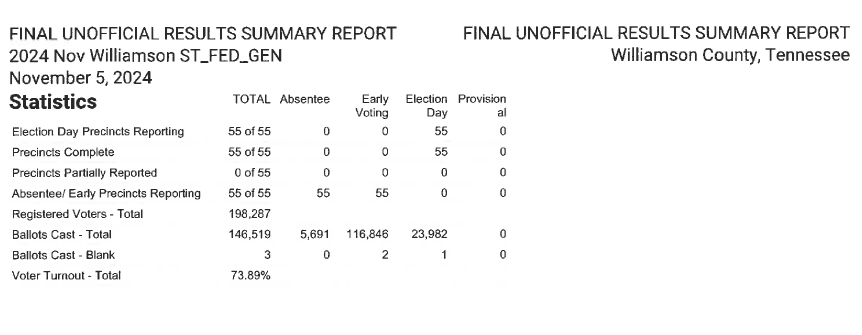
Well, we finally finished a grueling 15 days of early voting on Thursday; the results are below. In the November 5, 2024 election, we had 198,287 registered voters. Of that, 146,519 voted which was 73.89%. National elections always draw more voters, but the interesting thing is that 116,846 (79.8%) of the votes were cast early and only 23,982 (16.4%) on election day. The rest were absentee 5,691 (3.8%). If we follow the same trend where 79.8% of the votes are early and 16% are on day of, and 3% are absentee, then the total votes for this election will look like this: Early vote 16,023 (79.8%), Day of 3,293 (16.4%), Absentee 763 (3.8%), total vote of 20,080 which is a 10.6% turn out. Let us hope that considerably more voters show up on Tuesday.
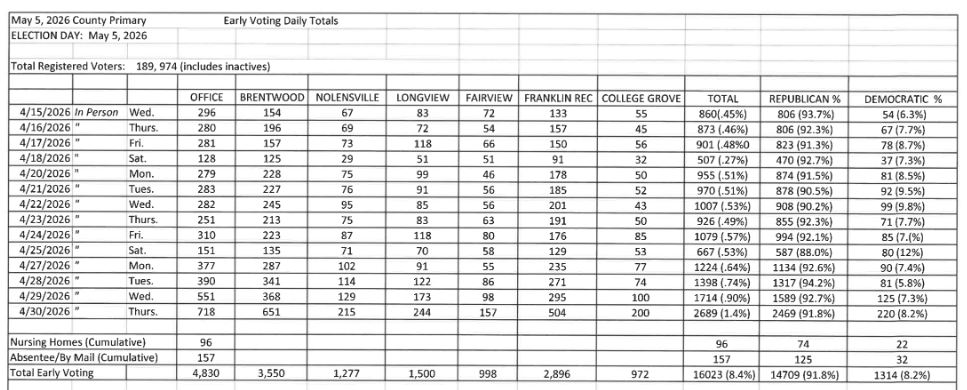
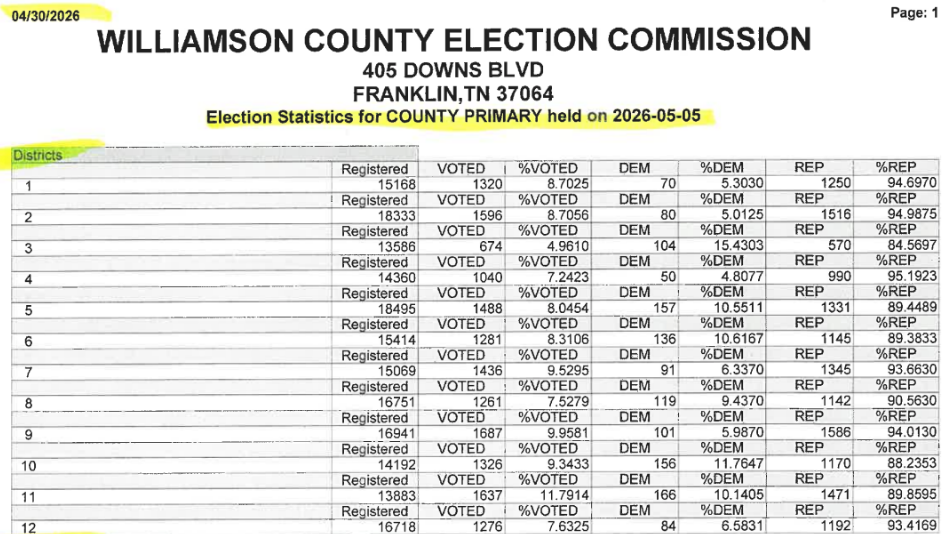
Why is the turnout so low? I wish I knew. Have we become so jaded that we think that these local races don't matter, that nothing can change? Is it that people are too busy to think about local politics? Whatever the reason, we as a county, are not engaged and that is not a good thing.
The next four years are going to be very challenging as we will be facing a string of significant capital expenses including a new jail, juvenile just complex and new courthouse. Along with that, we will most likely start transitioning from an all volunteer to paid fire department for the unincorporated areas of the county. We also have serious infrastructure issues, the cost of which, I don't even know how to calculate, much less pay for.
Voting on Tuesday
Voting is from 7:00 am to 7:00 pm and there are 27 locations around the county for you to vote. Go here for all the details.
My choice for County Mayor
I truly believe that Mary Smith is the best pick for our next county mayor. She has been a commissioner for four years and knows the issues very well. She has spent countless hours listening, learning and diving deeply into the workings of Williamson County and she will provide the kind of leadership we need for the next four years and beyond.
Special Event
I have been mentioning this for several weeks. Tomorrow, May 2nd, there will be a fund raiser put on by We Care Williamson County which is an organization that picks three worthy organizations/individuals to raise funds for. This year, my organization Operation Sound is one of the three recipients. It will be a lot of fun and I hope to see many of you there.

Update on legal counsel costs for the hospital sale
The county has retained the services of the law firm Foley & Lardner. They have just sent out an update of activity and billing. Go here for details.
Meetings this past week were:
Education Committee Court House Task Force Budget Committee Opiate Task Force BOMA Work Session BOMA Board Meeting For all other City of Franklin meetings go here
Meetings Next Week
Monday, May 4th
School Board Policy Committee Agenda will meet at 6:00 PM in the Training Center on the 1st Floor at the Williamson County Administrative Building located on the first floor at 1320 West Main Street, Franklin
The Budget Committee will meet at 4:30 pm in the Executive Conference Room of the Williamson County Administrative Complex at 1320 W. main, Franklin Agenda Minutes Resolutions Committee members: Chas Morton (C), Guy Carden, Betsy Hester, Paul Web, Mayor Anderson
Wednesday, May 6th
Highway Commission will meet at 8:30 am at 302 Beasley Dr.
Franklin. No other information at this time.
Thursday, May 7th
The Education Committee will meet at 4:30 pm in the Executive Conference Room of the Williamson County Administrative Complex at 1320 W. main, Franklin Third reading of WCS Budget Video Committee members: Steve Smith (C), Bill Petty (VC), Chris Richards, Drew Torres, Judy Herbert
The Public Health Committee will meet at 5:30 pm in the Executive Conference Room of the Williamson County Administrative Complex at 1320 W. main, Franklin Agenda/Minutes/Resolutions Video Committee members: Sean Aiello, David O’Neil, Chris Richards, Mary Smith, Barb Sturgeon
Enjoying Friday Recap? Take a minute now and forward it to 3 people. Copy this https://friday-recap.ghost.io/ghost/#/editor/post/680aad97ab206e0001e15b3f in your email.
The AI program I use is pretty accurate, but it does make mistakes from time to time and I don't always catch them. I provide agendas and videos/audios when I have them available and recommend that you watch the video and follow along with the summary to get the most accurate report.
One of the limitations of AI is that if a participant's name is not called out, then they are listed as participant 1, 2, etc. A limitation with audio, as opposed to video, is that one cannot always identify a person by voice alone. As imperfect as these AI summaries are, they still give a pretty good account of a meeting.
Williamson County School Board
No meetings this past week.
Williamson County Commission Meetings
Monday, April 27th
Opiate Task Force. No additional information
The Education Committee Agenda presentation Video Committee members: Steve Smith (C), Bill Petty (VC), Chris Richards, Drew Torres, Judy Herbert
AI Summary
Action Items
- [ ] Participant 1 - Confirm May 26 or June 1 meeting date with Diane and budget committee May 25 is Memorial Day so the regular meeting can't be held; need to confirm May 26 availability with Diane and/or coordinate a joint June 1 budget committee meeting.
- [ ] Participant 11 - Coordinate judicial task force meeting date to avoid conflict with June budget meeting Judge McLemore asked that the judicial task force meeting be coordinated so it doesn't conflict with the rescheduled education committee/budget meeting in June.
- [ ] Participant 6 - Confirm bond term vs. asset life for security/network technology items before full commission meeting Commissioner asked about bond term length vs. asset life for security/network items; he committed to double-checking before the full commission meeting.
- [ ] Participant 9 - Calculate 4% raise cost excluding unfilled positions To calculate the 4% raise cost applied only to filled positions (~97%) vs. the full budgeted headcount, so the committee can see the difference.
- [ ] Participant 9 - Bring ESCO energy savings payment waiver resolution next month The ESCO energy savings payment (~$1.1M/year) resolution is normally brought the following month; she confirmed it would come next month.
- [ ] Participant 9 - Email budget presentation slides to committee members Commissioners requested the slides for easier reading.
Overview
- Budget gap is now $17.8M (down from $22M at last meeting), driven by stronger-than-expected sales tax revenue and fund balance adjustments
- The 4% raise aligned with the mayor's recommendation costs $12.6M — the gap net of that is just over $5M
- Three capital resolutions passed: $5.5M for asphalt/roofs (3–2), $659,848 to shift growth bus funding to the education impact fee (unanimous), and $15.9M for security/network tech (3–2)
- No vote on the operating budget yet — committee plans to meet again around May 26th or jointly with the budget committee on June 1st before voting
- Key unknowns still outstanding: ADA split rate with Franklin Special School District and fiscal capacity number from the TISA formula, both expected late April or May
- Potential offsets being explored include the ESCO energy payment waiver (~$1.1M annually) and possible shared services between county and school system
Citizen comments on teacher pay
- Beverly Purvis (Williamson County Education Association president, Fairview) urged the committee to fully fund the district's budget including the 4% raise, arguing educators deserve the same treatment as other county employees and that without it they're effectively taking a pay cut given inflation
- Christy Biddinger (Brentwood, school board candidate) noted the district has already cut over $4M in operations and $5.7M in personnel, yet still faces a $20M+ gap, and the $12.5M cost of the 4% raise remains unfunded without additional support
Asphalt and roof funding resolution
- Passed 3–2 — resolution to fund $5,508,000 for 2025–26 major asphalt and roof needs
- This year's request is down from ~$12M last year after the district trimmed to the minimum needed based on projections
- Projects covered: roof replacements at Grassland Elementary, Allendale Elementary, and the maintenance building; turf replacement at Brentwood High and Nolensville High (the first two schools turfed); pavement at Spring Station Middle and Fairview Middle Commisioner Richards voted no on concern that these are repairs/replacements with a shorter lifespan than the bond term, citing Comptroller guidance against using bond issues for repairs — Sarah Bullock noted they differentiate repairs from full replacements and will double-check the bond term question before the full commission meeting
- Sarah Bullock clarified that when bonding, the district averages the life of all projects in the package, which brings the average up for shorter-lived items
Growth buses funding resolution
- Passed unanimously — resolution amends the 2025–26 budget to shift $659,848 for four special education growth buses from general fund balance to the education impact fee fund
- The four buses were already purchased ($164,962 each); county finance worked with the district to confirm they qualify as growth expenditures eligible for impact fee funding
- Net effect: fund balance increases by $659,848 and the budget gap shrinks by the same amount
- Special ed buses cost more than general ed buses due to required air conditioning for students with disabilities
Security and network tech resolution
- Passed 3–2 — resolution to fund $15,893,000 for 2025–26 security, network, and technology needs
- This is year three of a three-year plan to FOB all buildings with electronic locks and replace intercom/alert systems — if approved, every building and every lock will be complete
- Roughly $11–12M of this year's ask is the FOB/intercom work, which won't recur next year; the remainder covers cybersecurity infrastructure and camera replacements that will continue annually
- Commissoiner Richards voted no for the same reason as the roofs — concern about bonding for items with a shorter lifespan than the debt
Budget gap update
- Current gap is $17,796,415, down from $22M at the last meeting and $19.2M when Participant 9 last emailed the committee
- The latest drop came from a stronger-than-expected February sales tax number — projected at $12,836,000, came in at $12,816,000 (essentially on target), but the overall year-to-date sales tax is running about $1M over budget
- If the growth bus resolution is approved, the gap drops to approximately $17.1M
- Two unknowns could still move the number either direction: the ADA split rate with Franklin Special School District and the fiscal capacity figure in the TISA formula — both expected late April or May but not yet received
- Monthly sales tax receipts range between roughly $9.5M and $12.8M and are reported two months in arrears
Per pupil spending comparison
- Williamson County's per pupil expenditure for 2024–25 was $13,421, below the state average of $13,861 across 144 reporting districts — ranked 87th out of 144
- The figure includes federal grant funding and school nutrition, which Participant 9 flagged as slightly misleading when comparing to the general purpose school fund, though it's calculated consistently across all districts
- Franklin Special School District ranked 1st in the state; Davidson County ranked 2nd but dropped significantly, likely due to the end of COVID federal funding
- Participant 6 noted that being below the state average on per pupil spending is notable given Williamson County's above-average cost of living
Fund balance and spending trends
- Unassigned fund balance has declined steadily since 2021 as revenues grew 22.6% but expenses grew 25.26% — revenues are no longer keeping pace
- The minimum required 3% fund balance for July 1, 2026 is $17,155,033 — for the first time Participant 6 is aware of, the $12M budget gap marker is less than the required 3% floor
- Unspent budget at year-end flows back into fund balance — sources include encumbrances (open POs), unspent grant funds, unfilled position payroll savings, and operational stop-spending decisions made late in Q3
- The district had 180 unfilled positions in March 2025 and 141 in March 2026 (a ~20% improvement), though Participant 9 cautioned these are point-in-time snapshots and the number changes daily
- Total FTEs budgeted: 5,388 — current staffing is approximately 97%, meaning the 3% vacancy rate is the largest single contributor to year-end fund balance
4% raise cost breakdown
- The 4% raise costs $12.6M in aggregate and is structured as a net 4% increase — where the experience step roll is, say, 3%, only 1% is added on top to reach 4% total, not roll plus 4%
- The $12.6M covers all staff from superintendent to classified employees; the board would decide final distribution if funded, and Participant 6 expects they'd again give higher percentage increases to lower-paid staff as they did last year
- Last year classified staff received 2% while teachers got 4% (split between a chart increase and a base raise); the difference was redirected to supplement increases and additional paid days for ten-month employees
- The district is also mid-way through a salary study for classified positions — preliminary results go to the board at the May work session, but budget impact is likely a year out
Textbooks and digital learning
- The ~$10M textbook request covers the social studies adoption — books are in their 8th year and will no longer be on the state-approved list; the district buys a year early to secure materials and allow summer professional development before fall 2027 implementation
- The board rejected a proposal to defer $2.2M of the purchase to the following year's budget, prioritizing instructional readiness over the savings
- On digital alternatives: the state no longer grants waivers for OER-only approaches, and major publishers now bundle print and digital access together so buying one effectively means buying both. Superintentent Golden noted emerging research on screen time concerns, and the legislature passed a law this year requiring a screen time management policy in K–5 — the district expects to extend that policy to K–12
Instructional coaches
- Instructional coaches cost approximately $10M annually — a board motion to eliminate them failed for lack of a second after several hours of discussion
- Elementary schools have two coaches each (one math, one ELA/literacy) who work daily with teaching teams on formative assessment cycles and support new teachers
- Participant 6 considers coaches one of the two primary drivers of student performance growth alongside teacher team collaboration, and the state now lists coaching as a separate budget line, signaling its own recognition of the role
Potential revenue offsets
- The ESCO energy payment waiver (~$1.1M/year) is being explored with the mayor — Commissioner Herbert noted the resolution would normally come next month
- The Senator Johnson "A-grade school system" funding mechanism delivered less this year (~$2M reduction from prior year) because more districts qualified, and the fund was not increased by the legislature
- Commissioner Petty raised the wheel tax ($21 currently, one of the lowest in the state) as a potential revenue source but acknowledged it's too late to help this budget cycle
- Commissioner Torres suggested exploring shared service models between county government and the school system to reduce duplicative functions
- Commissioner Torres also asked for a breakdown of the $12.6M raise cost net of unfilled positions — Participant 9 agreed to provide a directional estimate
Next meeting scheduling
- No vote on the operating budget at this meeting — committee wants another month of data including the ADA rate and fiscal capacity numbers
- The May 25th regular meeting falls on Memorial Day, so it won't be held
- Commissioner Smith suggested either a standalone committee meeting around May 26th or a joint meeting with the budget committee on June 1st as the likely vote date
- Commissioner Smith asked to coordinate scheduling around the judicial task force, which is also targeting a June commission recommendation
Courthouse Task Force Agenda Video
AI Summary
Action Items
- [ ] Participant 1 - Compile agenda for next task force meeting Compile the agenda for the next task force meeting, including: reuse of non-historic courthouse components, 5-acre property availability, city-county property swap options, Heller's written historic courthouse proposal, court administrator recommendation, and stakeholder needs discussion.
- [ ] Participant 1 - Write up and submit the Hill property motion text for the May 11 commission meeting Write up the motion text (recommending the county commission authorize $175K to extend the Hill property contract 180 days) and submit it for use at the May 11 commission meeting.
- [ ] Participant 1 - Circulate available dates for next task force meeting Circulate available room dates between May 11 and June 8 commission meetings to find a next task force meeting date.
- [ ] Participant 1 - Solicit 5-acre property candidates within Franklin city limits from committee and public Open up the request to the full committee and public: anyone aware of 5-acre parcels within Franklin city limits should submit them to the committee before the next meeting.
- [ ] Participant 15 - Include Justice Center in Franklin's central parking study Engage the Justice Center as a contact in the central Franklin parking study kicking off this week, to incorporate courthouse parking needs.
- [ ] Participant 15 - Send city's list of potential courthouse site properties to task force before May 11 Provide a list of properties the city thinks the task force should consider (5+ acres, within or near downtown Franklin) before the May 11 commission meeting so it can be disseminated to members.
- [ ] Participant 15 - Follow up with Heller on how inflation was factored into City Hall cost analysis Look into how inflation and interest cost escalation were factored into the City Hall alternative site cost analysis and report back to Heller.
- [ ] Participant 2 - Send escalated total cost figures for Murray, Rutherford, and Sumner courthouses to task force Calculate total escalated project costs (not just per-square-foot) for Murray, Rutherford, and Sumner counties and send to the task force.
- [ ] Participant 6 - Prepare reuse/surplus evaluation for the courthouse annex and new courthouse building Prepare an evaluation of potential reuse options (or surplus/RFP path) for the 1970s annex and the newer courthouse building, similar to what Heller's group did for the historic courthouse. For discussion at the next task force meeting.
- [ ] Participant 6 - Confirm exact square footage of existing courthouse Confirm exact square footage of the existing courthouse building.
- [ ] Participant 8 - Document Franklin Preservation Partners' historic courthouse reuse proposal in writing Put his group's recommendations for the historic courthouse in writing — including the topographical map, 'The Way We Were' room, and coffee shop concepts — as a formal document for the task force.
Overview
- The task force's only motion was to recommend the County Commission authorize $175,000 in hard earnest money to extend the Hill property contract 180 days through September — passed unanimously
- The Hill property is offered at $17.5M, well below its $22.35M appraised value, but the current contract expires May 13th (day after the May 12th commission meeting), making the May 11th commission vote the critical deadline
- Jim Cross walked through comparable courthouse costs for Murray, Rutherford, and Sumner counties — escalated totals range from $36–39M (Murray, ~58K sq ft) to $91–124M (Sumner/Rutherford, 200–230K sq ft)
- The 2019–2020 master plan programs the new courthouse at 120,000 sq ft, but several members think that's too small and the program needs re-verification
- The Franklin Preservation Partners presented a preliminary proposal to repurpose the historic courthouse's first floor as a public history destination (topographical map, photo gallery, coffee shop) and preserve the second-floor courtroom largely intact
- Emily Wright (City of Franklin planning director) walked through zoning rules for both the current courthouse site and the HG Hill/Columbia Avenue site
- No alternative sites beyond the Hill property and a county-owned parcel near Franklin High School (Claude Yates, ~5.5 acres on Mack Hatcher) were identified as available and large enough — the next meeting will surface any other candidates
- Broad consensus that the 2020 rehab plan is not workable as presented, though rehabilitation stays on the agenda for due diligence
Hill property contract update
- The current contract expires May 13th, one day after the May 12th County Commission meeting
- The Hill property owner offered the county the property at $17.5M — below the county's own appraisal of $22.35M
- The owner's extension offer: 180 days (through approximately September) in exchange for $175,000 of the existing earnest money going hard
- Participant 5 confirmed he already signed the resolution, which will appear on the May 11th commission agenda
- Rogers noted that if the commission grants authority to proceed, the hard money authorization would come with it
Comparable courthouse costs and sizing
- Jim Cross reported escalated total project costs (including soft costs, FF&E, IT/AV — excluding nothing but the parking garage for Rutherford) for three Middle Tennessee courthouses:
- Murray County: ~58,000 sq ft, built at $472/sq ft, escalated to $519/sq ft today — total $36–39M; surface parking only
- Rutherford County: 200,000 sq ft, built in 2018 at $280/sq ft, escalated to $438/sq ft — total $91–100M; 330-car structured garage was separate at $6.2M in 2018 (~$19K/space), estimated $24–35K/space today
- Sumner County: 230,000 sq ft, built in 2024 at $305/sq ft, escalated to ~$336/sq ft — total $89–124M; includes one shelled floor which pulls the per-sq-ft average down
- Cross thinks the parking garage escalation to $24K/space is on the low side and expects closer to $30–35K/space for a realistic garage
- The 2019–2020 master plan programs the county's new courthouse at 120,000 sq ft, but Participant 10 and Cross both think that feels light given Sumner and Rutherford came in at 200K+ sq ft — the program needs re-verification
- Kevin noted the existing courthouse (historic plus judicial center) is approximately 103,000 sq ft per the 2020 Gresham Smith assessment, not including the Dan German building
- Design-to-completion timeline on comparable projects is roughly 36 months
- All three counties retained and repurposed their old courthouses rather than demolishing them
Historic courthouse reuse proposal
- The Franklin Preservation Partners (an 8-person group, working with 906 Studio on a pro bono basis) presented preliminary recommendations for the historic courthouse
- The group evaluated three alternatives — office repurposing, relocating the Five Points archives/museum, and a public history destination — and recommends the third
- Proposed three-part program for the first floor:
- A lit topographical map of Williamson County showing land grants, settlement patterns, and county formation (county historian Rick Warwick expressed interest in contributing)
- A portrait and photo gallery ("The Way We Were") drawing on Warwick's collection
- A coffee shop opening onto the plaza to serve as a rest and orientation point for downtown visitors
- The second-floor historic courtroom would remain largely intact for tourist access and continued court use
- Participant 7 raised a practical concern: the Sheriff must secure the building during jury trials (she starts a 6-day trial Friday), and there are only two public stairway access points and one ADA elevator to the second floor
- The balcony currently has only a ~2.5 ft high by 3 ft wide access panel — reopening it for public use would require significant historic renovation work
- The back portion (~17,000 sq ft, built in the 1970s) houses the Sheriff's Department, CID (in the basement), Congressman Van Epps' office, and the DA's office (two rooms) — it's expected to remain in use for 2.5–4.5 years until the Beasley facility is complete
- Participant 8 envisions the county retaining ownership and leasing to an appropriate long-term entity, with the increased visitor activity generating enough economic activity to justify the modest costs
City of Franklin zoning and site rules
- Emily Wright (City of Franklin Planning Director) presented zoning and Envision Franklin guidance for two sites
- Current courthouse site (Main Street design concept): significant institutional uses in the 16-block historic core are expected to stay in that area; building height and character are set contextually by historic district design guidelines on a block-by-block basis; parking must be at the rear
- HG Hill/Columbia Avenue site (Neighborhood Mixed Use design concept, Central Commercial zoning + Columbia Avenue Overlay District 1):
- Institutional uses are permitted
- Building height is 2 stories along Columbia Avenue and Folks Street, 3 stories along Plaza Street; a third story along Columbia Avenue requires Board of Mayor and Alderman approval
- Front setbacks: 5 ft minimum, 40 ft maximum; all parking must be behind the building
- Civic building type is not permitted — buildings must look like commercial mixed-use, house, or townhouse types; facades over 100 ft wide must appear as a series of buildings; 75% brick or natural stone required
- A historic edge treatment is required because the site is across from National Register properties — buildings should stay ≤2 stories along Folks and transition up to 3 stories along Plaza Street
- The county can override city zoning with a simple 51% commission vote, though it rarely does so — overrides have happened about 4 times in 11 years, mostly on civil engineering items like stormwater
- The City of Franklin is launching a central Franklin parking study this week and offered to engage the Justice Center task force to incorporate courthouse parking needs
Alternative courthouse sites
- The Hill property remains the only identified site that is publicly for sale, within Franklin city limits, and large enough (~5 acres) — that's the primary reason it has driven the discussion
- Kevin identified one county-owned parcel: ~5.5 acres at 106 Claude Yates (adjacent to Franklin High School), currently used as a soccer field and lacrosse field on Mack Hatcher — would require relocating sports facilities, and Mack Hatcher access has historically been denied by the state; Participant 5 raised significant concern about proximity to the high school from a security standpoint
- County-owned TVA land (Soccer East/West off Downs Boulevard) cannot be used for anything other than youth recreational sports per the TVA agreement
- Mayor Moore flagged several properties worth investigating: parcels on Eddie Lane (at least one over 5 acres, one family confirmed they're selling), the hardware store on Columbia Avenue, the former farmers co-op site, the BGA lower school property, and the Bethurum property — none are confirmed for sale
- Participant 8 noted the Franklin Preservation Partners' property across from the courthouse is roughly 2.5 acres, not for sale, and has an appraised value significantly above the Hill site
- Participant 7 noted that most alternative properties aren't publicly listed, and the county commission has historically avoided eminent domain — making willing sellers like the Hill property owner especially valuable
- The task force asked anyone (members, public, city) to identify 5-acre parcels within Franklin city limits before the next meeting
Motion to extend Hill property contract
- Participant 7 moved to recommend the County Commission authorize $175,000 in hard earnest money to extend the Hill property contract 180 days through approximately September, allowing the task force to continue due diligence — motion passed unanimously
- The motion is explicitly not a recommendation to purchase — it keeps the Hill property on the table while other options are explored
- Participant 1 will write up the motion language in writing to present at the May 11th commission meeting, either under Rogers' report (with Participant 1 giving the task force overview) or when Participant 5 introduces the resolution
Rehabilitation vs. new build
- Broad consensus that the 2020 master plan rehab proposal is not workable as presented, though the task force agreed to keep rehabilitation on the agenda for due diligence
- Kevin and Participant 7 both raised the core logistical problem: the courthouse requires a functioning holding cell and court security during any renovation, making it extremely difficult to relocate operations for the ~3-year construction period
- Participant 11 wants to keep rehab on the table — thinks the public expects the task force to have thought it through, even if the conclusion is that it's infeasible
- Participant 1 noted the hoped-for ~$100K in preliminary funding (pending May 11th commission approval) could be used to get a definitive answer on whether rehabilitation is feasible given those constraints
- The question of what happens to the existing courthouse if a new one is built (surplus, reuse, city-county swap) is also part of this agenda item going forward
Next meeting agenda and scheduling
- Next meeting will be scheduled between the May 11th and June 8th commission meetings — May 20th (Wednesday) or May 21st (Thursday) evening are the available room dates; May 27th is out (Participant 1 unavailable), and June 1st conflicts with county budget wrap-up meetings
- Participant 7 suggested 3:00 or 3:30 pm start could work for courthouse staff if needed, avoiding Mondays, Tuesdays, and Fridays
- Dates will be circulated to find the best availability rather than decided tonight
- Confirmed agenda items for the next meeting:
- Report on potential reuse of the non-historic courthouse components (annex and new courthouse building) — requested from Kevin's office or the mayor's office
- Discussion of any available 5-acre parcels within Franklin city limits
- City-county property swap possibilities
- Participant 8 to put his historic courthouse reuse proposal in writing
- Court administrator recommendation from the Triple J report — whether the task force wants to take it up
- Stakeholder space needs (likely further down the road, per Participant 13)
- Re-verification of the 120,000 sq ft program from the 2019–2020 master plan is a ~3-month process and would require more than the preliminary funding being sought
Tuesday, April 28th
Budget Committee Agenda Minutes 4/14 Minutes 4/21 Minutes joint meeting with Ed Committee 2/2 Transfers WCS Proposed Budget Video Committee members: Chas Morton (C), Guy Carden, Betsy Hester, Paul Web, Mayor Anderson
AI Summary
Action Items
- [ ] Participant 3 - Consult risk manager on extended school program insurance cost allocation Work with the risk manager to determine if a portion of insurance premiums should be allocated to the extended school fund rather than general operations.
- [ ] Participant 3 - Review insurance coverage for extended school program Check actual insurance coverage for the extended school program, including how premiums and claims are allocated between the extended school fund and general operations.
- [ ] Participant 3 - Send follow-up answers to budget committee questions Send any additional information or follow-up answers to questions raised at this meeting and the education committee meeting, as promised.
- [ ] Participant 8 - Investigate using educational impact fees for Franklin High wrestling renovation Work with Jason and legal to determine if the Franklin High School wrestling facility renovation (Title IX) can be funded through educational impact fees instead of the capital budget.
- [ ] Participant 9 - Email detailed capital budget project list to committee Send committee members a detailed breakdown of the building improvement/structural and athletics line items in the annual capital budget, including specific projects and costs.
Overview
- The budget committee is in its second review of the WCS 2026–27 budget with a current $17.8M gap — down from $22M in March but still unresolved
- The gap is driven primarily by a proposed 4% raise ($12.6M) and a high textbook year ($7.5M), partially offset by cuts of $7.7M in payroll and operations
- The committee voted unanimously to approve the central cafeteria fund ($21,615,317) and extended school program ($8,257,627), catching up with the education committee
- No decision on the general purpose school fund or the 4% raise — more state revenue data expected next month before the June commission meeting
- Several smaller gap-closing options were raised (ESCO waiver of $1.1M, impact fee use for capital, property tax growth) but none close the gap on their own
- The 92%-to-94% property tax collection rate change from last year created a $10M double-whammy that's now compounding the current shortfall
4% raise request from WCEA
- Beverly Purvis, President of the Williamson County Education Association, asked the committee to fully fund the district's 4% budget increase, including raises for all teachers and staff
- Her argument: a 4% raise isn't a bonus — it's an inflation adjustment, and without it educators are effectively taking a pay cut while other county employees receive the same increase
Budget gap update
- The gap has narrowed from $22M (March) to $19.1M (email update) to $17.8M (as of April 27th), driven by additional property tax assessment data and a one-time sales tax bump of ~$800K
- Rachel cautioned that neither the property tax adjustment nor the sales tax spike is expected to repeat — last month sales tax was $20K below budget, this month it was well above
- Sales tax data arrives ~2 months in arrears, so the strong February receipt actually reflects December (Christmas) spending
- A resolution coming Monday (May 4th) would shift $686K in special ed growth buses from the operating budget to the impact fee, shrinking the gap further if approved
- Still-unknown variables: updated ADA split with Franklin Special District and the state's fiscal capacity indicator for this year — education committee wants one more month before voting for those reasons
- Participant 4 noted that at a rough level, removing the $7.5M textbook cycle cost would bring the gap down to ~$10M
Fund balance breakdown
- Projected ending fund balance is ~$40M, down from ~$60M last year — the school system is drawing on it to cover the gap
- The required 3% unassigned fund balance (roughly $17M based on expenses) must be maintained for TDOE budget approval, leaving very little cushion
- Unassigned fund balance has dropped from $29M to $12M over the last several years; assigned fund balance (used to balance the budget) has grown from $16M to $59M in the same period
- The largest chunk of the projected $40M fund balance is the ~3% staffing gap (budgeted positions vs. actual filled positions at 97% fill rate)
- The school system moved up its spending freeze to February this year (vs. typically early Q4) and extended it to staffing — including holding an open assistant principal position for the last ~10 weeks of school rather than filling it
Per pupil expenditure data
- WCS per pupil expenditure for 2024–25 was $13,421, about $440 below the state average of $13,861 — and $400 below the prior year's gap of $40 below average, meaning the gap is widening slightly
- WCS ranked 87th out of 144 reporting districts in per pupil expenditure — below average statewide
- For context, Franklin Special District spent $22,455 per pupil; Knox County (next closest among high-fiscal-capacity peers) spent ~$13,900
- Over the last 5 years, WCS actual revenue grew 22.6% while expenses grew 25.2% — matching the 25% consumer price index increase over the same period
- Rachel flagged that the 2021–22 figures on the state's chart appear inaccurate (identical enrollment two years in a row) and has reached out to the state; the trajectory is still valid
Experience roll and raise mechanics
- The $12.6M raise cost is separate from the $4.1M experience roll — the total cost of a 4% raise including the roll is closer to $16.7M
- The 4% was budgeted as a combined target: if a teacher's roll is 3%, the budget adds 1% on top to reach 4% total — not roll plus 4%
- The roll breaks down as ~$3.6M on the teacher scale and ~$500K on classified positions; teachers past year 21 are off the scale and get no roll, so for them 4% is purely a flat raise
- 1% raise ≈ $3.15M in total cost (rough figure)
- The school board has not yet voted on how to distribute any approved raise — Participant 3 noted it's likely leadership would again get a smaller percentage with more emphasis on lower-paid staff, similar to last year
- A 2% July / 2% January split was floated; Participant 3 noted that would effectively be a 3% raise for the year (2% for 12 months + 2% for 6 months) with the full 4% base locked in for the following year — Rachel added there likely won't be fund balance available to fund the January portion
Textbook cycle costs
- The state runs an 8-year textbook adoption cycle across 4 core content areas (science, social studies, ELA, math), alternating every other year with less expensive subjects
- This year is a high-cost year: WCS is purchasing health textbooks for fall 2026 adoption and social studies books (K–2, ~$2.2M) for fall 2027 — total textbook spend swings from ~$3M in a low year to ~$10.5M in a high year, a ~$7.5M variable
- The board overruled a leadership recommendation to defer the K–2 social studies books (~$2.2M) to a mid-year amendment, with board chair Josh Brown arguing the purchase directly impacts the school's core mission
Cafeteria and extended school budget votes
- Budget committee voted unanimously to approve the central cafeteria fund at $21,615,317
- Budget committee voted unanimously to approve the extended school program at $8,257,627
- Both budgets contain no county tax funds; education committee had approved both in March
Annual capital budget and impact fee use
- WCS is requesting $13,665,000 in annual capital for 2026–27, down ~$500K from last year's $14,135,800
- The biggest line item increases are athletics (up ~$850K, driven by a Title IX wrestling facility renovation at Franklin High School) and building/structural improvements (up from $700K to $2.3M, covering trash compactors and work at Summit, Fairview, Franklin, Ravenwood, and Brentwood High Schools)
- Schools submitted ~$40M in capital requests; the $13.7M ask reflects prioritization by the maintenance team
- The Mayor raised whether the Franklin High wrestling renovation could be funded through the educational impact fee since it's a new structure and potentially a Title IX requirement — Phoebe said she'd look into it
- The county has over $100M in restricted impact fee funds with a 3-year spend window; with school enrollment growth flattening, there's pressure to identify qualifying uses before those funds expire
- Capital resolutions for the five-year plan (roofing, asphalt, safety) will be presented Monday May 4th
Other funding options
- The ESCO energy savings debt payment (~$1.1M/year) has been waived by county government in past years to boost school fund balance — Commissioner Herbert asked whether it could be waived retroactively for the current year as well; the answer is unknown
- County government's ~$105M fund balance could technically be loaned (not given) to the schools, but Phoebe noted it must be repaid by June 30th, making it a short-term bridge at best
- Participant 3 flagged that routing county pennies to schools and then backfilling county operations from fund balance is effectively the same can-kick, just less visible
- The Mayor noted Williamson County is now 3rd in the state for assessed property values (behind Davidson and Shelby), yet carries one of the lowest property tax rates in the state — less than half what it was 20 years ago
- The 92%-to-94% property tax collection rate assumption change from last year cost $10M over two budget years and is now a recurring base problem
- Participant 1 said he's not inclined to shift money from county general to schools given last year's experience; no consensus on any specific funding solution — the committee expects more clarity on state revenue figures before the June commission meeting
Franklin Board of Mayor and Alderman
Tuesday, April 28th
BOMA Work Session Agenda Video
AI Summary
Action Items
- [ ] Participant 11 - Commission engineering study for Mac Hatcher/South Royal Oaks pedestrian crosswalks Board consensus to proceed with engineering so a real cost can be brought back before committing to the full project.
- [ ] Participant 15 - Bring closed pension plan COLA resolution to next BOMA meeting for approval Christine noted manual calculations and retiree notifications are needed; board to consider approval at the next meeting.
- [ ] Participant 15 - Develop and present commemorative naming parameters for city hall park elements Alderman Brown flagged that 'sponsorship' is the wrong framing; commemorative/endowment model (like park benches/pavers) is the intent. Parameters need to be developed and brought back to the board.
- [ ] Participant 18 - Prepare detailed cost variance breakdown for city hall project Vice Mayor asked for a detailed variance breakdown showing what went over/under budget across ERPs, including the ERP 3 jump from ~$41M to $50M, tariff savings, furniture/tech overages, and items pulled out of GMP into bottom-line costs.
- [ ] Participant 26 - Provide buildable area analysis for HHO adjustment near Cool Springs Blvd/Mac Hatcher before May 12 public hearing Alderman Brown and Alderman Potts want to know whether, after applying the scenic corridor overlay and setbacks, any buildable area remains in the area near Cool Springs Blvd/Mac Hatcher where the HHO line is proposed to move. To be ready before the May 12 public hearing.
- [ ] Participant 27 - Provide updated HHO exhibit that matches the ordinance (buffer line unchanged) Vice Mayor noted the exhibit shows the 500-ft HHO buffer moving, but the ordinance only changes the HHO line itself. Need a corrected exhibit that matches the ordinance.
- [ ] Participant 6 - Verify Franklin commute-in/out numbers against Transportation Policy Board data Mayor asked to verify the commute numbers against what Franklin's Transportation Policy Board reported — both sides want to reconcile the discrepancy.
- [ ] Participant 6 - Send examples of employer-city housing partnership programs to Franklin board Alderman Burger asked for examples of communities where employers have partnered with local government (through chambers, businesses, etc.) to address housing — Patrick offered to provide them if messaged.
Overview
- Williamson County Association of Realtors presented a comprehensive housing needs assessment for Franklin — ~10,000 units need to be addressed (rental gap of ~3,800, for-sale gap of ~6,200), with affordability a major challenge across all income levels
- Wood Duck Court permit request approved in principle — FEMA conditionally approved flood plain changes, 90-day public comment period ends June 12; board wants accountability language added to the agreement
- New city hall GMP locked at $96M (projecting ~$95M); $9.3M in value engineering accepted to date; Vice Mayor Baggett wants a full cost variance breakdown across all ERPs, including what happened to tariff savings
- Furniture contract with Nashville Office Interiors approved at a higher-than-expected estimate — staff acknowledged it's the upper limit and will work to bring it down
- Armistead IDD application reviewed as a test case — staff scored it as meeting only 1 of 4 criteria (exceptional design) in full; board is generally supportive of the project but most members want to see more criteria met before formally approving IDD; formal public hearing process hasn't started yet
- Closed pension plan COLA of 2.5% effective July 2026 going to next voting meeting for approval
- Hillside Hillcrest overlay rezoning at 354 Franklin Road — public hearing set for May 12; Alderman Brown wants confirmation that no structure could be built in the area near Cool Springs Blvd and Mac Hatcher before supporting the line change
- Mac Hatcher pedestrian crosswalk at South Royal Oaks — estimated $300K–$400K for 2 ADA-compliant crossings; staff authorized to proceed with $15K engineering study to get a real cost before a final decision
Franklin housing needs assessment
- Patrick Bowen (Bowen National Research) presented findings commissioned by the Williamson County Association of Realtors — the first comprehensive housing needs assessment for Franklin in nearly a decade
- Franklin is projected to add ~3,500 households from 2025–2030, with the fastest growth among households aged 75+ (adding ~1,100) and higher-income households (over $150K/year)
- About 10,000 Franklin households are cost-burdened (paying over 30% of income on housing), including ~4,500 paying over 50%
- ~76,000 people commute into Franklin daily but don't live there — Bowen's concern is that housing unavailability drives this, and those workers spend their earnings elsewhere; over 14,000 commute more than 50 miles each way
- Multifamily rental occupancy is healthy at 95%, but all 8 affordable (tax credit/subsidized) properties are full with a waitlist of over 150 households
- Median apartment rents are ~$2,100+ for two-bedrooms; non-conventional rentals (houses, duplexes) average $2,600 for two-bedrooms and $3,500 for three-bedrooms — out of reach for most of the workforce
- Only 3 homes listed under $300K as of August 2025; median sale price was $815K in 2024, hovering just under $800K in 2025; for-sale availability rate is 1.2% vs. a healthy 2–3%
- The housing gap is ~3,800 rental units and ~6,200 for-sale units across all affordability levels — Bowen clarified this doesn't mean all must be built; some can be addressed through assistance programs like housing choice vouchers and first-time buyer programs
- Over 60% of employers surveyed said housing is impacting their ability to attract and retain workers
- Key recommendations include aligning affordable housing near transit, incentivizing workforce and senior housing, exploring density bonuses (Asheville, NC cited as a model), and engaging employers as partners
Wood Duck Court building permits
- ECG Wood Duck LP wants to pull permits for their last 2 of 8 buildings — the other 6 are permitted and near or at certificate of occupancy
- FEMA has conditionally approved the flood plain alteration (letter of map revision); a 90-day public comment period ends June 12, after which the revision becomes effective if no disputes are filed
- Alderman Potts raised the question of how the city holds the developer accountable to restore the site if FEMA ultimately doesn't approve — no existing bonds or financial withholdings are tied to this specific request
- City attorney suggested accountability language could be added to the agreement, and a lien mechanism was floated as a fallback option
- Vice Mayor Baggett noted the risk is low — FEMA has effectively approved it, the comment period is only ~40 days out, and Franklin Housing Authority is a partner on the project
New city hall construction update
- Current GMP is $96,006,552, projected to come in around $95M with ~$3.3M in contingency and allowances remaining ($1.6M projected to be spent)
- $9,334,651 in value engineering accepted to date; another $3.3M currently under evaluation
- Construction is on track — all large concrete pours finish after tonight's final two pours; tower crane expected down in July; no material backorders or supply chain issues
- Vice Mayor Baggett wants a full variance breakdown across all ERPs — specifically flagged ERP 3 jumping from ~$41–42M to $50M, and wants clarity on whether tariff savings (~$5M estimated earlier) were actually realized or absorbed elsewhere
- Chris Kepper (owner's rep) committed to pulling together the variance detail; noted tariffs have largely been eliminated with a small elevator-related exception (~$35K)
- Park elements (fountains, seating, swings) will be funded through commemorative contributions via Friends of Franklin Parks — not commercial sponsorships; $414K in park furniture is in the contractor scope but being evaluated for possible removal to the commemorative program
New city hall furniture contract
- Contract with Nashville Office Interiors covers selection, procurement, storage, installation, and warranty for all furniture — over 200 workstations plus meeting rooms, breakout spaces, reception, and lunch areas
- Current estimate is higher than the earlier soft bid, partly because the initial estimate didn't include all components; staff is treating this as the upper limit and will work to bring it down through value engineering
- Alderman Burger wants quality prioritized — commercial-grade furniture that holds up under heavy use, even if it costs more
- Vice Mayor Baggett noted the effective variance is ~$200K once the $900K demountable walls (pulled from contractor scope) are added back to the earlier furniture estimate
- Procurement is through Omnia, a cooperative purchasing program, to leverage standardized pricing across vendors
Armistead IDD application
- Armistead (developer Craig Hoover) was used as the first test case for Franklin's new IDD policy — the project is already fully approved and entitled; this was an informal review ahead of the formal public hearing process
- Staff scored Armistead against the 4 IDD criteria: full credit for exceptional design/quality development; no credit for attainable housing or redevelopment; partial credit for public infrastructure enhancement
- The project's exceptional design elements include a 5-day community charrette, agrihood concept preserving a farm dating to 1887, public art commitment, open trail system, and ~30 small businesses anchored around a local food hub
- Attainable housing was not part of the approved development plan or the notice of intent — staff gave no credit; Hoover acknowledged this but noted the range of housing types (multifamily, tiny homes, townhomes, ADU incentives) and argued attainability is relative in Franklin's market
- IDD financing targets ~$20–22M for Phase 1 infrastructure out of ~$54M total CIP cost; structured as a two-to-one value-to-lien ratio (state minimum), while Franklin's policy targets three-to-one
- Hoover explained the IDD is not a gift — it's ~7.5% money that enables faster delivery and keeps the capital stack local rather than bringing in outside equity; without it, the project would proceed more slowly
- Mayor said attainable housing is a non-starter for him and he doesn't see enough to be excited about the IDD for this project; Alderman Brown and Vice Mayor Baggett are inclined to support given the exceptional design credit but want more criteria met going forward
- Alderman Burger raised pedestrian connectivity to West Haven commercial across Hwy 96 — Hoover confirmed crosswalks at two signalized intersections and said he'd welcome a tunnel as a public-private partnership
- Formal process hasn't started — once the state legislation is signed and Franklin is a host municipality, a public hearing must be held within 60 days of a formal application; Hoover confirmed they will officially resubmit with more detailed responses to the criteria
Closed pension plan COLA
- Staff recommended a 2.5% cost-of-living adjustment to monthly benefits for retired recipients of the closed employees pension plan, effective July 2026, per the city's existing COLA policy
- Board will vote on the resolution at the next meeting — manual calculations and retiree notifications need to happen before the effective date
Hillside Hillcrest overlay rezoning at 354 Franklin Road
- Rezoning covers 202.6 acres south of Mac Hatcher / east of Franklin Road; public hearing set for May 12, 2026
- Staff (Joey) explained the HHO was established in 2008 based on contour lines, steep slopes, view shed analysis, and mature tree canopy inventory — staff has consistently not recommended modifications
- The proposed line change near Cool Springs Blvd and Mac Hatcher was included in the Envision Franklin conservation plan amendment because an existing Mallory Valley waterline easement had already cleared trees in that area; the new line captures the current canopy
- Alderman Brown wants confirmation before the public hearing that no structure (including a single-family home on a two-acre lot) could be built in the area near Cool Springs and Mac Hatcher after the line moves — staff said they don't believe it's possible given the scenic corridor overlay but will verify the math
- Alderman Potts wants to understand the total size of the area near Mac Hatcher and whether the slope analysis would change if the trees hadn't been removed
- Applicant's rep Greg Gamble committed to providing a lot and building pad analysis before the May 12 public hearing; noted the area could potentially serve as a trailhead for Roper's Knob access
- Vice Mayor Baggett asked whether the 500-foot HHO buffer line would move — staff confirmed the buffer is a static zoning boundary and would not be remapped; an updated exhibit will be provided to match the ordinance
Mac Hatcher pedestrian crosswalk
- Staff estimated $300K–$400K (conservative) to add 2 ADA-compliant pedestrian crossings at Mac Hatcher and South Royal Oaks, connecting the YMCA to neighborhoods on the other side — a third crossing isn't feasible due to a right-turn lane
- The cost is driven by needing to move and upgrade 2 signal cabinets and rewire the system; TDOT's $1.8M resurfacing project is already bid and moving forward
- Alderman Caesar supports doing the engineering and spending the money even at $300–400K, citing regular pedestrian safety incidents at the intersection
- Staff offered to proceed with a $15K engineering study to get a real contractor price before a final board decision — board agreed to let staff proceed administratively
AI Summary
Overview
- The board spent the bulk of the meeting on the Harlan PUD — a 311-acre mixed-use development west of Hillview Lane — approving all four related items (plan of services, annexation, zoning, and development plan) by 5–3 or 6–2 margins, with Aldermen Caesar, Peterson, and Blanton voting against most items
- The central controversy: whether Boyle Investment Company has secured the Good Pasture property needed for the northern road access required by Condition 30 — the Good Pasture owner withdrew their affidavit and, per Emily McGid, texted her that they will not sell to Boyle; Boyle says the property is under contract and expects to close by end of May
- Condition 30 is the key safeguard: no more than 150 units can be built in Phase 1, and Phase 2 cannot proceed without the northern road connection — any change to that access triggers a full development plan revision back through Planning Commission and BOMA
- The board also approved a $17.6M SRF loan (with $5.8M principal forgiveness) for the clean water facility design, and unanimously passed contracts for city hall redevelopment and a road impact fee offset agreement with Boyle for up to $4,598,243
- From executive session: board authorized a $55,000 offer of judgment in Millarski v. City of Franklin, and authorized enforcement and litigation on stormwater fines from the Caruthers Glenn subdivision
Recognitions and proclamations
- Mayor recognized the Grassland Middle School Game Day Cheer Team (39 athletes) for winning back-to-back Large Game Junior High National Championships in Orlando in February 2026, competing against 38,000+ athletes from 2,200 teams across 40 states
- Mayor proclaimed the week of May 4–8, 2026 as Franklin Water Week, highlighting the Harpeth River; Brittany Perez (stormwater management) noted this is the fifth Water Week and said the city will highlight a different water topic on social media each day
- Mayor proclaimed May 2026 as ALS Awareness Month; Cody Hilbert from the ALS Association thanked the board and noted the proclamation helps push advocacy efforts to the county level as well
Staff announcements
- City Administrator Stuckey announced Casey Anderson is now City Recorder and Sarah Schilling is now Senior Deputy City Recorder
- Stuckey highlighted an enhanced portal at franklyn.gov/boards-commissions-apply where residents can browse 14 boards and commissions, see vacancies, and express interest even when no vacancy exists
Harlin PUD public comment
- Residents from Shadow Green, Hillview Lane, and Coleman Road spoke overwhelmingly against the development, with traffic on Columbia Avenue and Mack Hatcher as the primary concern — several noted they've been coming to these meetings for nearly two years with no one except the development team speaking in favor
- Nikki Horner (Shadow Green HOA board) asked the board to vote no specifically on the Shadow Green road access, suggesting Century Court or a full Mack Hatcher extension as alternatives
- Rob Dotson raised a transparency concern: the Good Pasture affidavit withdrawal was known to staff before public comment began but was not disclosed to the public
- Emily McGid (1208 Hillview Lane) said she texted James Good Pasture during the meeting and he replied: "We will not be selling anything to Boyle, my promise to you"
- Wendy Atcheson questioned how eastbound Mack Hatcher traffic would be addressed and challenged the board to drive the corridor during peak hours for a week
- Alison Peeler cited Boyle's Berry Farms history — originally approved for 1,146 units, now at 3,010+ — as evidence that developer commitments don't hold
- Greg Gamble (applicant's rep) clarified that Coleman Road and Himpeck Lane improvements are approved by the County Highway Commission, Columbia Pike improvements are approved by the state and city, and the revised plan preserves the vast majority of Hillview Lane with a new road going north from it rather than through it
Harlin PUD board debate: road access and infrastructure
- The Good Pasture affidavit withdrawal dominated debate — Boyle's Adam Ballish said nothing has changed and the property is under contract; staff confirmed the affidavit withdrawal doesn't change the staff recommendation because Condition 30 still requires the northern connection before Phase 2
- Alderman Caesar's concern is not the project design but the traffic on Columbia Avenue and Mack Hatcher, which he says has been a problem since at least 2009 and isn't resolved — he's not confident those roads will be fixed before Phase 2 comes out of the ground
- Alderman Blanton wants the Hillview Lane preservation commitment locked in before supporting the development plan, and is worried about restarting a two-year fight if the Good Pasture situation falls through
- Vice Mayor Baggett argued the phased approach is actually a safeguard: if Boyle can't acquire the Good Pasture land, they're capped at 150 units and Hillview Lane stays unchanged — and noted the T-DOT plan for Mack Hatcher Southwest Extension already calls for this road connection regardless of Harlin
- Baggett also noted the project is 0.67 units per acre — lower than every city zoning district except AG — and that Boyle is paying $8M (roughly half the county's annual road budget) for off-site improvements the county has not funded
- Alderman Potts walked through the infrastructure timeline: Coleman and Himpeck improvements required before the first building permit in Phase 1; off-site roadway work starting 2027; Columbia Avenue and Mack Hatcher intersection completed before Phase 2 starts, estimated 2029–2030
- Alderman Potts also confirmed staff's position: 30 reviewers across 10+ departments reviewed the plan of services and all paperwork for annexation is in order
- Alderman Barnhill voted no on annexation citing uncertainty about the northern access, but yes on the zoning ordinance and development plan
Harlin PUD votes: annexation and zoning
- Resolution 2025-24 (plan of services for annexation): passed 6–2 (Caesar and Peterson voting no)
- Resolution 2025-25 (formal annexation of 311.21 acres): passed 5–3 (Barnhill, Caesar, and Peterson voting no)
- Ordinance 2025-06 (rezoning to Plan PD, 0.78/32,000/80 district and Hillside Overlay): passed 6–2 (Caesar and Peterson voting no)
Harlin PUD development plan vote
- Resolution 2025-26 (development plan with 15 modifications of standards): passed 5–3 (Blanton, Caesar, and Peterson voting no)
- Key safeguard in Condition 30: capped at 150 units in Phase 1; Phase 2 (including the Main Street piece and units 151+) cannot proceed without the northern road connection — any revision to that access requires a full development plan revision back through Planning Commission and BOMA
- Phase 1 access is from Coleman Road; an emergency-only gated connection to Hillview Lane is included in Phase 1 — no existing Hillview Lane resident is separated from their neighbors or from emergency services by any gate
Harlin PUD contracts
- Contract 2025-0158 with Boyle Nashville LLC for road impact fee offset agreement: up to $4,598,243 — passed unanimously
- Contract 2025-0110 with Boyle Investment Company for parkland impact fee and construction agreement for Harlan PUD: passed unanimously
REDI district ordinance
- Resolution 2026-01 (establishing REDI district policies via resolution) was withdrawn — passed unanimously
- Ordinance 2026-05 (amending Franklin Municipal Code Title 24 to add Chapter 5 establishing REDI district policies and procedures): passed 7–1 on first of two readings, with Alderman Peterson voting no and calling the IDD approach "crazy"
Clean water facility loan
- Board approved Resolution 2026-29 authorizing a $17.6M SRF loan at 2.35% interest for engineering design of the clean water facility, with $5.8M in principal forgiveness (net repayment ~$11M over a 5-year term) — passed unanimously
- Additional wastewater capacity is needed by 2034; the new plant is targeted to start discharging to the river by 2032, with reservoir discharge beginning around late 2033 after a year of quality control testing
- Total construction cost estimate has a wide range with a median of $347,786 (noted as very early pre-design); the rate study passed under Ordinance 2025-09 assumed $20M for design and $325M for construction
- A full cost-of-service study covering rates and impact fees is planned to begin in 2027; current rates do not yet account for the HOBAS repair costs identified after the last rate study
City hall redevelopment contracts
- Resolution 2026-16: contract with Hamilton Young for commercial brokerage and property management for the city hall redevelopment block commercial spaces — passed unanimously
- Contract 2026-0056 with Nashville Office of Interiors for furniture for the new Franklin City Hall — passed unanimously
City administrator spending authority
- Resolution 2026-18 rescinds Resolution 2022-84 and raises the city administrator's unilateral contract authority from $50K to $75K, and adds authority over right-of-way and easements — passed unanimously
- Stookie noted the authority has been used roughly 13–14 times in the past 3 years and that he brings items below the threshold to the board when he thinks they'd want to weigh in; all uses of the authority are reported to the board
Executive session outcomes
- Board authorized the city attorney to make a $55,000 offer of judgment in Millarski v. City of Franklin (Williamson County Circuit Court, docket 22 CV 329) — passed unanimously
- Board authorized the city administrator and city attorney to pursue enforcement and collection of stormwater fines from the Caruthers Glenn subdivision construction, including litigation if necessary — passed unanimously
For all other meetings go here.
Election Commission
If not me, who?
If not now, when?
“Now faith is the substance of things hoped for, the evidence of things not seen (Heb. 11:1)
“We work hard with our own hands. When we are vilified, we bless; when we are persecuted, we endure it; when we are slandered, we answer gently.” (1st Corinthians 4:12-13)
"Do nothing out of selfish ambition or vain conceit. Rather, in humility value others above yourselves" (Philippians 2:3)
Blessings,
Bill
Community resources
If you like Friday Recap, check out these other grassroots conservative projects!
- Grassroots Citizens of Williamson County Provides free tools and information to help grassroots conservatives exercise their citizenship here in Williamson County.
- Tennessee Voters for Election Integrity is helping restore confidence in Tennessee Elections.
- TruthWire Local news and commentary.
- Williamson County Republican Party is one of the most active parties in the state and captures the conservative heart of Tennessee.
- Mom's For Liberty Williamson County is dedicated to fighting for the American family by unifying, educating and empowering parents to defend their parental rights at all levels of government.
- Tennessee Stands produces video media, podcasts, and live events, and provides social commentary on relevant issues in our state.
- M4LU is a new site developed by the national Mom's for Liberty but generated right here in Williamson County. The mission of M4LU is to to inform, equip, and empower parents with knowledge, understanding and practical tools.
Help educate citizens of Williamson County
Want to support Friday Recap? Forward this newsletter to 3 people and invite them to subscribe. Use this link
Was this newsletter forwarded to you? Subscribe now by clicking below.