Friday Recap February 20th, 2025


My Comment
My Campaign
I am running for a second term as commissioner for District 10. You can go to Votebillpetty.com to get to my website. There are going to be over 40 people running for office in the primary on May 5th. Each district has two commissioners and District 10 has five people running. I will need all the support I can get. If you want to help, please go to my website and donate and/or get involved.
Final Candidates for the May 5th primary
Candidates running for county office in the May 5 primary.
Candidates for August 6th primary*
Candidates running for state and federal office office in the August 6th primary. Filing deadline is noon March 10th.
*This is a correction from earlier reports where I had the primary listed for May 5th.
If you don't know who is running for office in your district or where and when to vote, you can go to Grassrootscitizens.com
Also, there is an interview with me by grassrootscitizens here
Meetings this past week were:
Human Resources Committee Williamson County School Board of Education Law Enforcement Committee and Public Safety SSDS Task Force
Meetings next week:
Tuesday, February 24th
Opioid Abatement Task Force will meet at 1:30 pm in the executive conference room in the county building at 1320 W. Main St. Agenda
Wednesday, February 25th
The Property Committee will meet at 5:30 pm in the Executive Conference Room of the Williamson County Administrative Complex at 1320 W. main, Franklin Committee members: Ricky Jones (C), Barb Sturgeon (VC), Brian Clifford, Jennifer Mason, Matt Williams. There is no agenda yet.
Thursday, February 27th
SSDS Task Force will meet at 9:00 pm in the executive conference room in the county building at 1320 W. Main in Franklin. They will continue to dig into our septic tank regulations. Their final report will be ready April 1st.
For all Franklin City meetings, go here
Property taxes are due next Saturday the 28th.
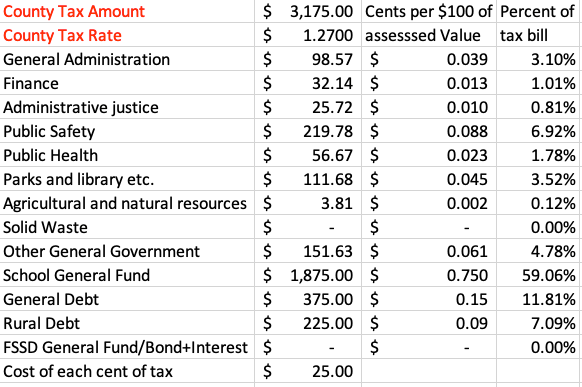
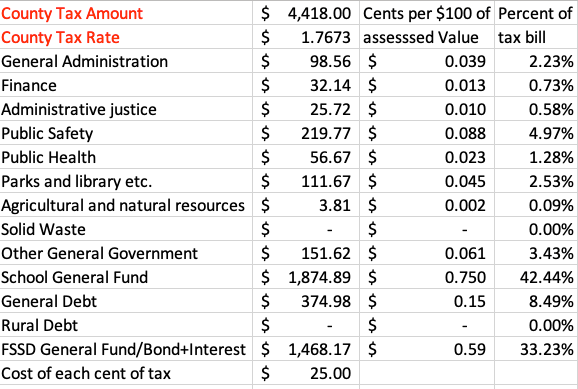
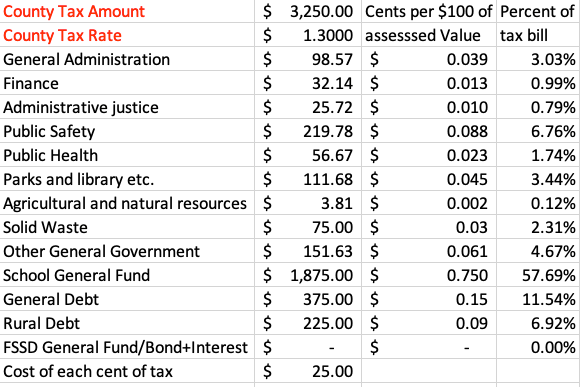
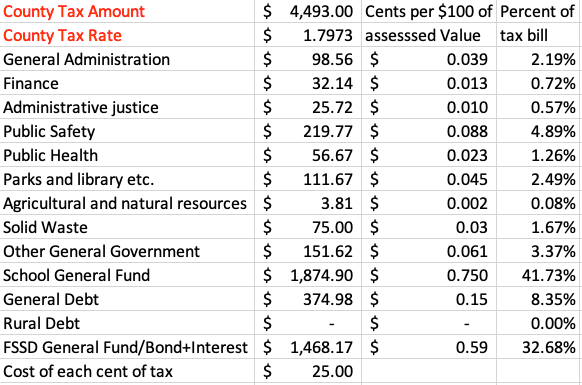
The county tax rate is $1.30 per $100 of assessed value. There are four variations of our County tax rates that I show below in my spreadsheets. City taxes are in addition to these rates and you can see that on your tax notice.
Since the average price of a home in Williamson County is $1,000,000, all calculations below are based on the appraised value of $1,000,000
Franklin, Spring Hill $1.27 You will notice that Solid Waste is zero and that is because both municipalities handle their own solid waste.
Franklin+FSSD $1.18 county+ $.5873(Franklin Special School District). Not all of Franklin is in the FSSD District, but much of it is. You will notice that both solid waste and Rural Debt, which is the debt on schools K-8, are zero, and are replaced by FSSD. The $1.18 number is derived by subtracting Solid Waste $.03 and Rural Debt $.09 from the county tax of $1.30.
County unincorporated areas and Brentwood, Fairview, Thompson's Station and Nolensville $1.30
County unincorporated area+ FSSD County $1.21+FSSD $.5873
If you want to check my calculations, go here for the county's published tax rates.
2025-26 county budget
If you are interested in going deeper into the county budget, you can go here. Since we are in budget season, I plan on writing a number of reports on the budget process as each department is considered.
Enjoying Friday Recap? Take a minute now and forward it to 3 people. Copy this https://friday-recap.ghost.io/ghost/#/editor/post/680aad97ab206e0001e15b3f in your email.
The AI program I use is pretty accurate, but it does make mistakes from time to time and I don't always catch them. I provide agendas and videos/audios when I have them available and recommend that you watch the video and follow along with the summary to get the most accurate report.
One of the limitations of AI is that if a participant's name is not called out, then they are listed as participant 1, 2, etc. A limitation with audio, as opposed to video, is that one cannot always identify a person by voice alone. As imperfect as these AI summaries are, they still give a pretty good account of a meeting.
Williamson County School Board
Thursday, February 12th
School Board Work Session met Agenda Video I was unable to publish last week because there was a delay of information from the school district.
AI Summary
Action Items
- [ ] Jen Sauer - Include current textbook info in committee report When sending textbook committee decisions to the board before spring break, include information about what textbooks schools currently use so board can compare to new recommendations.
- [ ] Rachel Farmer - Share county budget meeting dates with board Once Jamie provides the county budget and education committee meeting schedule (expected tomorrow), forward those dates to all board members.
- [ ] Rachel Farmer - Provide enrollment projection accuracy data Compare last year's enrollment projections to actual enrollment to show how accurate the forecasting was.
Overview
- WCS faces a $39M budget gap for 2026-2027, up from $31M last year, with a proposed budget of $579M that includes a 4% raise ($12.6M) the district doesn't currently have funding to cover
- District made $7M in cuts including $4.2M in payroll reductions and $3M in operational cuts, but major cost drivers offset savings: social studies textbook adoption ($7.5M increase), Innovation Center operations ($1.3M new), and experience roll ($4.1M)
- Enrollment projected to decline 0.2% to 40,533 students with net staffing reduction of 12.7 positions
- Cell phone pilot program launches February 17, 2026 at Independence, Nolansville, Fairview, and Page high schools plus Page and Brentwood middle schools using three different storage methods to gather data over 9 weeks
- Grassland and Hillsboro renovations passed commission approval and will begin summer 2026 as 3-year construction projects
- Open enrollment applications reached 973 since opening February 4, 2026, with window closing April 15, 2026
Cell phone pilot program
- Pilot starts Monday, February 17, 2026 and runs for 9 weeks (second half of third quarter and first half of fourth quarter) with spring break in the middle
- Independence High School testing Faraday pouches with 50 students in control group and 50 in experimental group
- Nolansville High School requiring all students to keep phones in backpacks (phones should be off, only accessed during lunch per high school policy)
- Fairview and Page high schools having every student drop phones at classroom entrance on racks
- Page and Brentwood middle schools placing 100% focus on recording every instance teachers notice cell phones out to gather accurate data on visibility during school day
- Dr. Webb explained every occurrence will be documented across all pilot schools, including warnings that don't result in office referrals, to capture true frequency of cell phone use
- District will gather data on student referrals and collect feedback from parents, students, and teachers at all pilot locations
- Dr. Mafe will help disaggregate data and present findings to board after pilot concludes
- Results will inform board policy addition for next year addressing appropriate storage of cell phones
Screen time committee progress
- Committee met Tuesday, February 14, 2026 and continued drafting WCS technology use guidance document
- Andy created matrix organizing topics into 4 major areas of focus: safety/privacy/operational procedures, training and support, monitoring, and compliance with federal/state laws
- Committee members reviewed grade band groups (K-2, 3-5, 6-8, 9-12) and filled in blank areas where topics weren't previously addressed for specific grade bands
- Some topics like monitoring and compliance will have identical language K-12, while others will vary significantly by grade band
- Draft guidance document will include principles, key expectations for teachers/students/families, and "what it looks like in practice" sections
- District plans to create multiple formats including graphics, videos, and podcasts to share guidance with community in addition to written document
- Timeline shifted approximately 1 month behind original schedule due to robust discussions and need to ensure document quality
- Next committee meeting scheduled for Tuesday, March 17, 2026 to review draft and gather feedback on format and content
- Final draft expected in April 2026 before moving to family resources work in May 2026
- Jenny Lopez shared community feedback that K-5 parents strongly prefer minimal technology use, while 6-8 parents prioritize safety and security of devices and prefer reading from books over small Chromebook screens
- Lopez raised concern that apps from curriculum purchases don't require proven efficacy like IEP apps do, meaning students can become "guinea pigs" when apps don't perform
- Committee discussed recommendation to review apps every 3 years to ensure learning is taking place
- Teachers in committee noted natural progression toward balanced approach with better retention and critical thinking when using physical books and paper/pencil
Textbook adoption update
- Full-day publisher meeting held January 16, 2026 at PD Center with textbook committee representatives including teachers, parents, and community members
- Committee met with each publisher for approximately 50 minutes with time for teacher debriefing between sessions
- 3 CTE teachers not on committee but teaching courses up for adoption were invited to attend publisher meeting
- Public reviews hosted at PD Center with 6 dates initially scheduled, 2 canceled due to ice storm, and 2 additional dates added as makeup
- Digital access to materials available on WCS website with both paper and electronic public comment forms, but no public comments submitted as of February 16, 2026 (though some visitors attended and asked questions)
- Teacher recommendation form opens Tuesday, February 17, 2026 and closes Thursday, February 19, 2026
- Form captures teacher name/email, material selection, and instructional focus reasoning addressing new board policy requirement about alignment to standards, content accuracy, research-based strategies, teacher support materials, and differentiation opportunities
- Approximately 75-80 total health and CTE teachers will review materials, with 80 health/PE/lifetime wellness teachers spending district PD day February 17, 2026 reviewing materials with publishers present
- Textbook committee meets Monday, February 24, 2026 at 4:30 PM to review consolidated teacher data and make final recommendation
- Jen will send committee recommendation to board before spring break so members can review ahead of March 19, 2026 work session
- Board vote scheduled for Monday, March 23, 2026
- All middle school and high school health/PE/lifetime wellness resources up for adoption are brand new (not currently used materials)
- 1-2 CTE courses have current materials included as adoption options
- After selection, district will order instructional materials in April 2026, create training and implementation plans, and work with teacher groups to develop scope and sequence before last day of school so teachers can create pacing guides over summer
- Training for teachers scheduled throughout summer and on first district-wide day back before students return
- Board members Margie and another member suggested creating scope and sequence before textbook selection to help teachers evaluate which materials best align with desired standards progression, particularly for upcoming large social studies adoption
Enrollment projections
- Current enrollment as of last week: 40,597 K-12 students
- Projected end of first month enrollment: 40,533 students
- Projected decrease of 64 students (0.2% decline) from current enrollment
- Actual end of first month compared to projected end of first month showed greater decrease, but current projections use actual current enrollment versus projected future enrollment
- Enrollment projections broken down by individual schools and grade bands in board packet
- Ms. Nunnley works to analyze individual areas and schools including developments coming in to make projections
- This enrollment number will be used going forward for budget planning purposes
Staffing and position changes
- Staffing standards for 2026-2027 mirror 2025-2026 with no substantive changes, only minor cleanup for readability
- Net reduction of 12.7 positions projected in aggregate across district
- Teacher positions estimated to decrease by approximately 6.26 positions (number subject to change based on final enrollment)
- Innovation Center adding 4.5 new positions
- Couple of schools will gain assistant principal positions due to staffing standards
- Position Control Report (PCR) is summary only at this stage because open enrollment is ongoing and enrollment trends are still developing
- Principals haven't seen their PCRs yet to avoid causing concern with numbers that aren't finalized
- Two bus attendance positions added to PCR based on demonstrated need
- Staffing reductions primarily result from enrollment decline, but 64 students across 50 schools averages 1 student per grade level per school, which typically doesn't trigger staffing standard changes
- Final staffing numbers will be determined after open enrollment closes and enrollment is established
Budget revenue assumptions
- Most revenue information won't be available until February, March, and April 2026
- Sales tax projected to increase 3%
- Property tax projected to increase 1%, providing modest revenue increase
- TISA (Tennessee Investment in Student Achievement) formula kept same as current year except for actual enrollment adjustment, resulting in slight decrease
- State base amount for TISA was $7,295 in current year (up 3% from $7,000 previous year), but district receives approximately $4,400 per student after formula reductions
- Governor's budget includes additional TISA funding, but specific allocations to base, weights, and outcomes not yet available
- District doesn't budget for grant money (revenue or expenses) because it's never guaranteed
- State provided teachers $2,000 one-time bonus in current year ($7M total)
- Last year county government changed property tax revenue projection from 92% to 94% of collections as one-time fix, which provided $5M more revenue but reduced fund balance available for 2026-2027
Budget expenses and operational changes
- Original 2025-2026 budget: $562M
- Revised 2025-2026 budget: $581M (includes grants, carryover, donations, state bonus, and $3M for buses)
- Proposed 2026-2027 budget: $579M
- Operational increase of $4.2M includes $7.5M for textbooks and $706K for Innovation Center operations
- Without textbook and Innovation Center increases, operations would have decreased 4.8%
- Technology spending went down, and many departments made cuts after evaluation
- Experience roll (teachers moving up pay scale and classified employees' 5-year bumps up to 16 years) costs $4.1M
- 4% raise as recommended by mayor costs $12.6M (not currently funded)
- District made $4.2M in payroll reductions so far, with approximately half from eliminating unfilled positions and half from adjusting retirement rates, Social Security, and Medicare based on actual payroll trends
- District made $3M in operational cuts
- Total cuts of $7M made across payroll and operations
- Two-thirds of 24-26 departments either stayed flat or reduced budgets
- Some increases unavoidable: janitorial contract increases annually, building/content/liability insurance went up
Innovation Center costs
- Total added cost for Innovation Center: approximately $1.3M
- Operational costs (supplies, materials, utilities, janitorial): $706K (estimates until building is operational)
- New salaries: approximately $600K for 4.5 positions
- Approximately $300K of operational budget is startup money for materials that may not need repurchasing
- Innovation Center will be standalone building (unlike ESC which shares utilities with Franklin High School, making direct comparison difficult)
Budget gap and funding challenges
- Current budget gap: $39M (compared to $31M last year)
- Gap calculated from projected revenue plus estimated fund balance minus total expenditures minus required 3% fund balance
- Fund balance (savings account) decreased because last year's 94% property tax projection change was one-time fix that didn't increase actual revenue
- When revenues don't exceed expenses, fund balance doesn't grow
- County government historically asks district to use fund balance before pursuing property tax increases
- District doesn't project having funding for 4% raise ($12.6M) included in budget
- Mr. Golden emphasized district intends to include 4% raise in budget per county parameters but must confer with WCEA leadership through PECA process about allocation
- County government will need to provide help if 4% raise is to happen
- Budget must be submitted to county commission before April 1, 2026
- If county commission doesn't approve budget by July 1, 2026, previous year's budget continues
- If no budget approved by July 31, 2026 and discrepancy exists between school and county operating budgets, budget committee's recommendation becomes law automatically
- Mayor Anderson gave his departments 5% operational reduction parameter on Monday, February 2, 2026, but WCS worked independently before that guidance
- District's approach was drilling down on departmental needs and analyzing actual prior year expenditures rather than across-the-board cuts
- Historical context: cumulative inflation since 2020 is approximately 25%, and district's overall expenditure budget increased 30% over 7 years, closely tracking inflation
Family tuition and school fees
- Board asked to approve family tuition rate of $9,797 for 2026-2027 (local share of per pupil expenditure)
- Tuition rate is not revenue source - very limited use for students finishing school year after moving out of district or moving into district with non-contingent contract
- Students moving during first semester can finish school year by paying second semester tuition
- Students moving into district during school year pay tuition upfront and receive reimbursement when they move in
- Rate emphasizes approximately two-thirds of per pupil expenditure comes from local funding (substantially different from most Tennessee districts)
- Total per pupil expenditure including state portion estimated around $12,800 (includes some capital, federal, and cafeteria components)
- 66% of general purpose budget comes from local revenue, less than 1% from federal
- 216 employees benefited from employee tuition rate in current year
- Employee tuition rate is $2,000 first year, then reduces over 5 years per SOP, with 5-year employees paying no tuition (family rate, not per student)
- School fees for 2026-2027 recommended at same levels as 2025-2026: elementary fees and extracurricular-only secondary fees
- Board eliminated curricular fees last year, opening door for schools to do fundraisers instead
Construction projects and open enrollment
- Grassland and Hillsboro renovation projects passed county commission approval on Monday, February 9, 2026
- Athletic field lights project did not pass and will be revisited with different approaches
- Bids for Grassland and Hillsboro opened Friday, February 6, 2026
- Construction is 3-year project for both schools starting summer 2026
- Renovations include replacing flooring, ceiling tiles, and door hardware - substantial construction work
- Eric from prior year already completed significant design work and engineering
- Open enrollment opened Wednesday, February 4, 2026 and closes Wednesday, April 15, 2026
- 973 applications received as of February 16, 2026 (includes open zone, employees, siblings, and continuing in feeder pattern)
- Zoning staff reviews every application individually to ensure compliance with board policy before moving forward
- District currently has approximately 2,500 total students attending schools via open zone
- Typically see application flurry at beginning and end of window with trickling in between
- Last open enrollment cycle: 4 schools (Independence, Franklin, Ravenwood high schools and Spring Station Middle) had lotteries
- Spring Station resolved 100% of lottery requests
- Three high schools had families denied (exact numbers to be provided to board)
Annual capital requests
- Total annual capital request for 2026-2027: $12.8M (down from $14.9M fully funded last year)
- Requests broken into general fund (high schools 9-12) and rural fund (K-8 schools) due to Franklin Special District bond funding requirements
- Franklin Special receives commensurate bond money for K-8 projects based on average daily attendance ratio (typically 6.5-7%)
- State provides allocation in April or May, causing slight budget adjustments
- Annual capital covers items that happen throughout year like HVAC unit failures and regular maintenance
- Includes computer purchases on refresh cycle
- Other capital outlay line covers furniture district-wide (desks, chairs, new classroom furniture)
- County commission historically funds annual capital expenses, recognizing need for regular maintenance
- Sometimes county funds partial amounts and projects get pushed to next year (roofing projects often patched until full funding available)
- County commission requested annual capital be included with budget evaluation so they can review everything at once
Technology spending analysis
- Board member requested historical technology spending breakdown across general purpose, annual capital, and five-year capital
- 2020-2021 total technology spending: $12M
- 2025-2026 total technology spending: $29M
- Security line increased from minimal in 2020-2021 to $9M in 2025-2026 due to key fob projects for all indoor doors (funded from five-year capital)
- Personnel costs increased primarily due to raises with only 1 employee added in IT department for 2 additional schools
- Faculty/staff laptop refresh: $1.2M in 2020-2021, $6.7M in 2025-2026 (number fluctuates based on refresh cycle, not steady increase)
- District skipped laptop refresh in 2023-2024 due to budget cuts, causing spike in 2025-2026 compounded by Windows 11 requirements
- Chromebook spending relatively flat once district moved from lease to purchase model
- Early years showed low numbers ($2.9M) due to lease payments, then spike ($7M) when transitioning from lease to purchase because state wouldn't allow leasing
- Chromebooks on 4-year cycle per industry standard, but district extends life when devices are in good shape
- Current Chromebooks are past 4 years but still in use
- K, 1, and 2 scheduled for Chromebook refresh in 2026-2027 with K and 1st being one-to-two ratio and 2nd grade one-to-one (currently budgeted)
- Eliminating K-1 Chromebooks completely would save approximately $1.3M every 4 years
- Following year after 2026-2027 will be middle school refresh (full 3 grades one-to-one, significantly higher cost)
- 4-year cycle: middle school, then high school, then grades 3-5, then K-2
- District maintains surplus Chromebooks for replacements and repairs, using working devices from replaced grade bands for elementary replacements to extend cycle
- Tim McNeese (IT Director) researched historical data across multiple budget categories as funding sources varied by year based on county commission requests
Tuesday, February 17th
School Board Meeting Agenda Video.
AI Summary
Action Items
- [ ] Jason Golden - Pull skipping data and discipline records Last 3 semesters of high school students skipping school with corresponding discipline actions, plus comparison to discipline from recent walkout incidents once completed.
- [ ] Jason Golden - Bring walkout policies to policy committee Discuss policies 6.2 (attendance), 6.3 (code of conduct), and 6.306 (disruption) related to student walkouts and mass demonstrations.
Overview
- Board approved family tuition rate for 2026-2027 based on state per pupil revenue and expenditure calculations
- Board approved school fee schedule for 2026-2027 with no changes from current year—no curricular fees at secondary level, elementary voluntary fee remains, extracurricular fees continue
- Extensive discussion of IEP procedures and behavioral interventions following public comments about classroom disruptions—federal law limits removal of students with IEPs to 10 days per year unless behavior is not a manifestation of disability, or 45 days for drugs, weapons, or serious bodily injury
- Board members requested data on student walkout incidents and discipline to inform upcoming policy committee discussion—incidents occurred at Brentwood (students walked during lunch) and Ravenwood (less than 50 students checked out with parent permission)
- DECA students advocated for program support and highlighted workload concerns—78.6% of students reported heavy workload during conference weekends
- Mr. Welch raised concerns about employee health insurance costs after learning a teacher's take-home pay is less than insurance premiums for large family with health conditions
Behavioral interventions and IEP procedures
- Brad Davis asked why behavioral modification classrooms aren't being used more frequently for students who repeatedly destroy classrooms and exhibit violent behaviors
- Golden explained IEP teams determine least restrictive environment for each student and can adjust placement when behaviors indicate student cannot receive instruction in current setting
- Federal law limits schools from removing students with IEPs from their services to 10 days total per school year
- Students can receive same discipline as non-IEP students if behavior is not a manifestation of their disability, determined through IEP team meeting with parents
- Three behaviors allow 45-day removal even if manifestation of disability: possession of illegal drugs, possession of weapon, or causing serious bodily injury
- Schools must continue providing IEP services during any removal period and conduct testing to determine if IEP changes are needed
- Dr. Driggers asked about protecting other students when one child has routine outbursts requiring classroom evacuation
- Dr. Royer explained school counselors and administrators use de-escalation techniques and provide support to affected students, including moving severely traumatized students to different classrooms when needed
- Dana Osbrooks clarified serious bodily injury definition from federal regulations: substantial risk of death, extreme physical pain, protracted disfigurement, or protracted loss of bodily function—case law shows 10 out of 10 pain for multiple days as threshold
- Mr. Cash expressed concern about timeline to change IEPs for recurring behavioral problems, noting disruption to other students losing class time
- Osbrooks explained IEP changes can take 10 days if data exists, or 45-60 days if evaluations or functional behavior assessments are needed
- Golden noted "stay put" provision requires students to maintain same services during disputes involving courts
Student walkout policy and discipline
- Steve Hickey urged board to create policy for students who leave school without authorization to protest, citing legal jeopardy for failure to perform in loco parentis responsibilities
- Golden stated district does not condone or coordinate student walkouts and tries to talk students and parents into finding outlets that don't disturb class time
- District published guidance in In Focus article explaining discipline for skipping class is addressed in board policy 6.3 with potential additional measures depending on specific behavior
- Brentwood incident involved students walking during lunchtime and returning by end of next period—Principal Kidell still conducting individual interviews to determine discipline
- Ravenwood incident involved less than 50 students who checked out with parent permission before last period rather than walking out of class
- Mr. Bostic noted some students discussed filling out parent sign-out forms and deleting them from parents' phones to avoid detection
- Mr. Galbraith requested data on students skipping school over last 3 semesters plus resulting discipline to compare with walkout discipline
- Golden and Osbrooks confirmed plans to bring walkout policies to policy committee meeting for discussion and potential revisions
- Policy 6.306 addresses not only disrupting school activities but also encouraging other students to disrupt
- Golden emphasized student safety concerns when activities introduce variables outside normal school control and requested parents contact principals if children are considering participation
Elliot Franklin addressed board policy 6.306 regarding disruption of school activities
- Franklin emphasized this is not about politics or silencing students—it's about timing, safety, and policy
- Franklin noted walkouts during instructional time disrupt classrooms, put teachers in difficult positions, and affect students expecting a full instructional day
- Franklin raised safety and liability concerns when students leave campus during school hours
- Franklin advocated for consistent policy enforcement regardless of the issue being protested
- Franklin suggested students can organize before/after school or request designated time that doesn't interrupt instruction
- Franklin called for balancing respect for student voices with protecting the learning environment
JP Kukulka, junior at Ravenwood High School, shared how DECA changed his career aspirations from neurosurgeon to entrepreneur and corporate lawyer
- Kukulka explained DECA teaches students to analyze business problems, present under pressure, think critically, and build leadership skills
- Hundreds of students participate in DECA across Williamson County and thousands across Tennessee
- Survey conducted by DECA team found 78.6% of students said workload is heavy and over 80% said they hadn't received noticeable change in workload
- Kukulka believes issue represents lack of communication between teachers and students rather than lack of effort from either side
- Kukulka asked board to help teachers and students work together to redefine manageable workload during conference weekends
- John Astin, junior at Ravenwood, emphasized DECA builds team building, problem solving, and communication skills that companies increasingly seek
- Astin noted DECA provides practice for public speaking and business pitching that students don't experience until college otherwise
- Golden thanked students and noted DECA (Distributive Education Clubs of America) focuses on business-related opportunities and skills
Screen time and student well-being
- Dr. Stacy Jagger, licensed marriage and family therapist and registered play therapist supervisor, addressed screen time impacts on children
- Jagger reported seeing more anxiety, sleep struggles, shortened attention spans, and difficulty with peer relationships across schools and homes
- Jagger noted children's nervous systems are constantly stimulated without enough time to rest, play, and connect in real life
- Jagger recommended schools balance technology with hands-on learning, outdoor play, creative projects, and face-to-face collaboration
- Golden reported screen time committee includes board members, parents at all grade bands, and administrators
- Committee started with personal devices, now discussing district screen time, and will address communications with parents about outside-of-school time as third piece
- Next committee report with recommendations on district screen time expected in May 2026
Legislative priorities for public education
- Beverly Purvis spoke on behalf of educators and school staff during Tennessee General Assembly session
- Purvis emphasized working together between school boards, educators, parents, and communities produces better outcomes
- Legislative priorities include respecting educators as professionals, fully funding public schools regardless of zip code, protecting local decision-making and transparency, and ensuring public dollars strengthen public schools
- Purvis asked board to use their voice during legislative session to advocate for policies that strengthen rather than fragment public education
- Purvis noted locally elected school boards bring credibility, context, and lived experience to state-level conversations
Employee health insurance costs and coverage
- Mr. Welch shared concern from teacher in his neighborhood whose take-home pay is less than what she pays for insurance due to large family with specific health needs
- Teacher noted if husband loses job, family must choose between mortgage and taking children to doctor
- Golden explained teacher pay ranges from $51,012 to $76,578 for bachelor's degree holders with 0 to 21 years experience
- Golden stated it's possible large portion of income could be consumed by medical bills for families with multiple health conditions, though insurance premiums alone likely wouldn't consume entire salary
- District participates in self-insured plan with county government costing multiple tens of millions annually
- Retirement insurance benefit allowing employees to maintain coverage by paying premiums ended for anyone hired after 07/01/2009
- State plan also ended similar benefit around 2011 due to unsustainable costs
- Golden noted district's per pupil expenditure is around 50th percentile statewide, and 85% of budget is people, resulting in relatively lower income than neighbors despite higher cost of living in Williamson County
Family tuition rates and school fees
- Board approved family tuition rate for 2026-2027 based on state per pupil revenue and expenditure
- Tuition rate applies to out-of-county students, though district policy generally doesn't allow out-of-county attendance except for students finishing school year after moving, rising seniors finishing career, or families with non-contingent contracts before moving in
- 216 employees benefited from policy allowing full-time employees to bring children from out of county
- 132 employees' children currently paying tuition
- 168 employees' children passed 5-year mark and no longer pay tuition
- Average tuition revenue over last 3 years: $143,000
- Board approved school fee schedule for 2026-2027 with no changes from current year
- Secondary schools have no curricular fees following substantial change made last year
- Elementary voluntary fee remains in place
- Extracurricular fees for secondary schools continue as approved
- Wyatt reminded community that February 18, 2026 is last day for public review of textbook materials for health, wellness, and CTE from 4:00 PM to 6:00 PM at professional development center
Williamson County Commission Meetings
Tuesday February 17th
Human Resources Committee. Agenda/packet Video Retirement proposal Committee members: Judy Herbert (C), Jennifer Mason (VC) Greg Sanford, Tom Tunnicliffe, Bill Petty, Brian Beathard. Commissioner Tunnicliffe was absent
AI Summary
Action Items
- [ ] Claire Cochran (head of HR Dept.)- Conduct impact study on vacation credit for new hires Research how giving years-of-service credit for applicable prior experience would affect current employees and department operations. Return to committee with findings.
- [ ] Claire - Return with buyout program proposal Present vacation buyout program details to committee after meeting with mayor and finance director.
- [ ] Participant 4 - Draft resolution on vacation accrual changes Resolution to be brought back to HR committee in May. Excludes longevity increase. HR committee members will sign.
Overview
- Committee approved full-time Mental Health Court coordinator position funded by state grant with no county expense
- Claire Cochran presented comprehensive vacation accrual reform to address recruitment and retention challenges—proposal simplifies structure from 5 tiers to 4 tiers, adds 2 personal days after probation, and increases early-career accrual rates to align with 75th percentile compensation philosophy
- Christie Borden highlighted $90,000 cost to train each 911 telecommunicator and strong support for vacation changes since employees currently can't take vacation first year
- Committee requested impact study on crediting prior work experience for new hires and asked for separate vacation buyout program proposal
- Resolution will go to commission in May with July 1st effective date, all HR committee members co-sponsoring
Mental Health Court coordinator position
- Committee approved full-time coordinator position for Williamson County Mental Health Court
- Position funded through state grant from Department of Substance Abuse and Mental Health Services with no in-kind county expense
- Previous coordinator was through treatment agency that's dissolving
- Tracy McKinney explained coordinator responsibilities include managing grants and reports, coordinating with attorneys, judges, treatment staff, and law enforcement, and providing weekly updates to judge
- State grants are steady and guaranteed annually unlike federal grants that can be discontinued
- Resolution passed 4-0
Proposed vacation accrual changes
- Claire presented vacation reform proposal after 3.5 years as HR director to modernize accruals that haven't been updated in decades
- Current system requires employees to work full 30 days before starting to accrue, then accrue at 6.66 hours per month for first 5 years
- Proposal simplifies 5-tier structure to 4 clearly defined tiers and aligns with 75th percentile compensation philosophy adopted for salaries
- Changes include adding 2 personal days after probation period (use or lose, no carryover or payout), increasing accrual rates for 0-4 year employees, and boosting middle years to improve retention
- Bereavement policy expands to include stepchild, step-parents, and grandparents-in-law
- Claire emphasized no immediate cost impact since overtime is locked to budgets and all vacation remains subject to departmental approval based on operational needs
- Research packet compared Williamson County to school system, City of Franklin, State of Tennessee, Murfreesboro, Spring Hill, Brentwood, Rutherford County, Maury County, and Knox County
- Accrual continues to be based on hours worked with 120 hour minimum per month to accrue
- Personal days must be pre-approved and can't substitute for sick days
- Statistical research shows employees who stay 5 years typically remain long-term, making 0-4 year retention critical for reducing training costs
- Commissioner Herbert noted younger generation prioritizes family time and work-life balance differently than previous generations
- Longevity pay increase was listed in materials but Claire clarified there's no mayor support this year due to budget constraints
- Current longevity structure pays $50 per year starting at 5 years of service and increases cumulatively each year thereafter
Christie Borden's support for vacation changes
- Christie leads 911 telecommunicator department and provided strong operational perspective on recruitment challenges
- Mission Critical Partners operational study found 911 is one of lowest departments for taking leave because employees don't have enough accrued
- Department strategically times hires but struggles when new employees wait 2 months before getting first vacation day
- Training period lasts 6-8 months at console with employees needing time away for mental health
- Calculating salary, training, and all staff time invested, each new hire costs approximately $90,000 not including overtime
- Department loses employees to City of Murfreesboro 911 partly due to better vacation benefits
- Employees work 4 day per week schedule to help with work-life balance but additional vacation time remains critical competitive factor
- Telecommunicators can't work from home unlike many competing employers, making vacation flexibility more important
Front-loading vacation discussion
- Commissioner suggested drawing line in sand at 3 or 6 months when employees become eligible for full 10 days instead of accrual system
- Claire noted experience with front-loading at previous employers—very attractive for recruitment but can create challenges for departments with high turnover
- Some department heads supported front-loading while others had concerns about managing requests from new employees
- Two personal days in proposal serve as hybrid approach providing early flexibility without full front-loading risk
- Personal days don't create liability since they don't roll over if employee leaves
Crediting prior work experience for vacation
- Commissioner Mason raised major recruitment hurdle—state employee with 20 years would drop from 24 vacation days to 12 days when joining county
- Claire acknowledged she walked away from 5 weeks front-loaded vacation to take HR director position and vacation was pivotal decision point for Lisa's hiring
- Sheriff Hughes supports vacation reform because department struggles to recruit officers who don't want to lose 3 weeks vacation from previous employer
- Claire shared experience at healthcare company that credited applicable experience one-to-one—nurses left Vanderbilt and St. Thomas because they could maintain vacation accrual level
- Applicable experience must be directly relevant and verifiable (nurse to nurse, accountant to accountant)
- Some employers cap credit at 5 years rather than giving all years of experience
- Commissioner Mason requested impact study showing how crediting experience would affect current employees and operations
- Claire explained study would analyze how many additional vacation days would enter employee banks and how departments would manage increased requests
- Committee wants to see multiple implementation options before deciding on approach
- This would be separate initiative from main vacation proposal moving forward
Vacation buyout program concept
- Commissioner asked about vacation buyout after employees accrue maximum
- Claire has experience with buyout programs at large healthcare and manufacturing companies where they were very popular
- Programs typically allow 1-2 buyouts per year with minimum bank balance requirement
- Employees under 4-5 years probably wouldn't be eligible due to insufficient accrued balance
- Benefits include removing liability from books, better tax treatment for employees approaching retirement, and helping long-term employees manage accruals
- Finance departments favor buyouts because vacation liability comes off books immediately
- Better to pay dollars out now than 10 years from now when employee retires
- Claire has discussed concept with mayor and finance director Phoebe Riley and has their interest
- Will develop formal proposal and bring back to committee separately from main vacation changes
Next steps and committee action
- Committee directed county attorney to draft resolution for main vacation proposal excluding longevity increase
- Resolution will go to commission in May rather than March to allow time for HR committee review
- All HR committee members will co-sponsor resolution
- Proposed effective date is July 1st
- Claire will conduct impact study on crediting prior work experience for new hires and return with findings and implementation options
- Separate vacation buyout program proposal will be developed and brought back after further discussion with mayor and finance director
Williamson County Planning Commission Agenda, Video
AI Summary
Overview
- Commission threatened to call the bond on Terre Farrell Road drainage project if Jones Company doesn't resolve issues by summer—county staff expressed frustration that ponds don't drain and work isn't built per plans
- Commission approved Stevens Valley Section 12 reapproval and established RDE bond at $503,000
- Commission approved Tombs Creek Farm Nursery site plan with added condition requiring Tennessee Department of Agriculture licenses to be shown before final approval
- Chairman denied non-agenda item request because no formal request was submitted to staff, despite applicant's claim of a meeting on January 15, 2026
Terre Farrell Road drainage and erosion control
- Brent Thaney reported phase two slope repairs are 80% complete—fabric, drains, and stone installed, but final grading and restabilization still needed after rough work done before ice storm
- County requested additional cores for phase two road, geotech contractor scheduled to perform testing
- One additional small road repair may be needed depending on core results
- Wastewater road material determination is close to finalization, but county staff doubts engineer's claim that it can be stabilized
- One new dropout opened up near wastewater road that geotech will evaluate
- Fire pit site plan is under county review, phase one engineer sent back comments today
- County staff confirmed progress is happening but many issues remain open, including ponds that don't drain and significant deviations from plans
- County will hold maintenance bond and won't release it in the next couple months
- County staff warned if issues aren't resolved by summer, they'll call the bond
Stevens Valley Section 12 RDE bond
- Commission approved reapproval for section 12 containing zero lots on 0.77 acres off Stevens Valley Boulevard
- Reapproval adds condition for roads, drainage, and erosion control bond
- RDE bond established at $503,000
- Section has 0.53 acres as open space
- Water and sewer provided by Harpeth Valley Utility District
- Jeremy Westmoreland with CSDG confirmed no objections to staff conditions
Tombs Creek Farm Nursery site plan
- Commission approved site plan for nursery on 10.08 acres off Arnold Road with condition requiring Tennessee Department of Agriculture licenses before final approval
- Song Choi plans 15 greenhouses totaling 66,600 square feet for cut flower production for retailers with no retail activity on-site
- Operation will have 3 to 5 employees initially, scaling up to 15 at full capacity with roughly one employee per greenhouse
- Greenhouses are high tunnel units using polyethylene for natural sunlight, no LED grow lights or forced flowering
- Existing house and septic system will remain for residential use, not connected to nursery operations
- Portable toilets will serve employees—building code doesn't require permanent restroom facilities
- Tennessee Department of Agriculture indicated license turnaround is typically two to three weeks after request submission
- Construction will be phased over multiple years, starting with two greenhouses in year one
- Irrigation from wells, no retail activity on-site
Non-agenda item request procedure
- Keith Brelican requested time for property owner to speak on non-agenda item, noting owner was 15 minutes away
- Aaron confirmed no formal request was received for non-agenda item, only learned about it when Brelican arrived at meeting
- Brelican referenced meeting on January 15, 2026 with himself, owner, and Aaron, claiming owner followed up with email
- Chairman denied request, stating item should wait until March 19, 2026 meeting since commission wasn't notified ahead of time
Wednesday, February 18th
Law Enforcement and Public Safety Agenda/Packet Video
Committee members: Tom Tunnicliffe (C), Greg Sanford (VC), Pete Stresser, Matt Williams, Bill Petty. Commissioners Stresser and Williams were absent
AI Summary
Action Items
- [ ] Participant 6 - Talk to CTAS about task force participation Discuss with CTAS about having a representative on the courthouse task force as a non-voting guidance member and report back to committee.
Overview
- Committee approved $90,611.77 in budget amendments across three departments, all funded by external sources
- Approved creation of full-time Mental Health Court coordinator position funded by state grant, with position contingent on continued grant funding
- Established Courthouse Task Force with 6-month timeline to analyze future judicial facility needs, building on 2020 criminal justice master plan
- Task force will include 4 commissioners (chair and vice chair must be commissioners), judges, city representatives, and other stakeholders
- Committee debated adding district attorney and public defender representatives but withdrew motion to let full commission decide on final membership
Budget amendments and funding approvals
- Approved $30,611.77 for Office of Public Safety covering overtime, supplies, and vehicle maintenance for Texas emergency assistance, funded by Tennessee Emergency Management Agency
- Approved $56,000 for Sheriff's Office from state law enforcement training program for SRO salary supplements and in-service training
- Accepted $4,000 donation to Sheriff's Office for purchasing iPads and equipment from annual contributor
Mental Health Court coordinator position
- Approved full-time coordinator position, bringing previously subcontracted work in-house
- Position funded by state grant with funding included in next year's budget
- Bobby Cook (County Council) confirmed position automatically terminates if grant funding is not secured
- Commissioner Petty noted coordinator handles extensive program coordination including counseling and support services for participants
- HR committee approved position unanimously the previous night
Courthouse Task Force establishment and membership
- Commissioner Aiello proposed task force to analyze courthouse and judicial facility needs, continuing work from 2020 Triple J report
- Task force has 6-month timeline through approximately August 2026, constrained by election season and current commission term
- Membership structure requires 4 commissioners with chair and vice chair positions reserved for commissioners to spearhead any resulting resolutions
- Proposed membership includes judges, City of Franklin alderman and administrator, and other stakeholders
- City of Franklin representatives included due to parking discussions and requirement that courthouse be located within Franklin city limits
- Commissioner Mason advocated for adding district attorney and public defender representatives, noting 20 years of courthouse overcrowding with staff working in hallways on folding tables
- Commissioner Sandford motioned to add DA and PD representatives, then withdrew motion to let full commission decide on stakeholder composition
- Bobby Cook agreed to contact CTAS (County Technical Assistance Service at University of Tennessee) about providing non-voting expert guidance, particularly their attorney specializing in law enforcement facilities
- Task force has no fiscal impact beyond advertising public meetings unless separate resolutions request funding for consultants, design work, or feasibility studies
- Gresham Smith conducted 2020 criminal justice master plan and served as JJJ architects
- Commissioner Aiello noted first task force discussion will determine if Gresham Smith needs to update statistical projections from 2020 report
- Task force will hold public hearings similar to SSDS task force model
- Commissioner Mason noted property on Highway 31 requires decision by March 2026 or April 2026, potentially before task force completes work
- Upon completion, commission must receive task force report but is not required to adopt recommendations
- Resolution passed unanimously with DA and PD membership question deferred to full commission
Board of Mayor and Aldermen
Thursday, February 19th
Budget and Finance Committee Agenda Video
AI Summary
City of Franklin Budget and Finance Committee 2192026
Date: Friday, February 20, 2026 at 8:52 PM
Duration: 2:27:33
People: Participant 1, Participant 2, Participant 3, Participant 4, Participant 5, Participant 6, Participant 7, Participant 8, Participant 9, Participant 10, Participant 11, Participant 12, Participant 13, Participant 14, Participant 15, Participant 16, Participant 17, Participant 18, Participant 19, and Participant 20
Overview
- City received 34th consecutive year of Certificate of Achievement award from GFOA with zero audit findings in FY25
- Franklin earned AAA bond ratings from both Standard and Poor's and Moody's, joining approximately 100 cities nationwide with multiple triple-A ratings
- Citizen survey showed 7% growth in confidence in city government, 8% increase in value for taxes paid perception, and 11% growth in citizens feeling informed about community issues
- Property taxes due February 28, 2026 (Saturday), with Williamson County Trustee's Office open until 4:30 PM on February 27th
- Bond closing scheduled for March 12, 2026 with competitive bids opening March 5, 2026
- Most department budgets increasing 2-5% primarily due to estimated medical premium increases
- Finance requested contract specialist position to manage growing number of construction and software contracts including water plant, City Hall, and Southeast Park projects
- City Court requested full-time deputy court clerk to handle 7,500-8,000 citations annually (up from historical levels) and reclass part-time assistant deputy
- HR requested organizational development specialist position, citing $1,400,000 annual cost of employee disengagement at 18% rate versus $78,000 position cost
Finance department budget and contract specialist request
- Finance oversees security and management of city's financial interests including accounting, reporting, investing, payroll, vendor payments, purchasing, and annual audit
- Department received no audit findings in FY25 audit and successfully implemented GASB 101 for compensated absences
- Finance requested repurposing unfunded contracts administrator position (currently on law department org chart) into funded contract specialist role
- Contract specialist would focus on major projects including water plant, City Hall, and Southeast Park, plus manage ongoing software and on-call contracts
- Position would relieve pressure on accounts payable team as vendor volume grows
- Margaret reached out to city attorney who supported the request since job description completely reworked to focus on financial support rather than paralegal work
- Personnel budget increasing 2%, operations staying within 5% without interfund transfers
Interfund transfer accounting methodology
- City uses interfund transfers to account for time general fund departments spend on water management, storm water, and sanitation funds
- Transfers reviewed annually using different metrics per department—some based on work orders, others on budget percentage, number of posts, or tickets
- Management fellow Sky Gerhardt working on updated interfund transfer spreadsheet
- City very conscious of not overcharging enterprise funds and has actually lowered transfers in recent years after full assessment
- Majority of transfers go against water and sewer as largest funds
- Finance showing operations budget both with and without interfund transfers for transparency—$1,900,000 to run department but $1,660,000 net after transfers
Billing and licensing operations and online beer permit portal
- Billing and Licensing handles collecting and billing for water, wastewater, storm water, sanitation, plus business tax, alcohol tax, hotel motel tax, and various permits
- Department fully staffed with no proposed org chart changes
- Team had smooth transition to interim White House location on 9th Avenue with high in-person and drop box payment volume continuing
- Call volume reached approximately 36,700 calls through year (projected from 33,000 through November)
- Department launching online beer permit portal moving away from paper applications for both business and special event permits
- Portal will collect $100 annual privilege tax through electronic payments
- Communications team partnering on portal using their new special event permit system
- Beer Board approval process not changing—portal only streamlines application submission
- Department collected 100% of beer permit fees on time through diligent tracking, interdepartmental cooperation with building and neighborhood services for site visits
City court case management system and staffing requests
- Judge Born completing fourth year as city court judge and seeking reappointment in 2026
- Court launched new modern case management system in December 2025 after two years of work with IT
- New system includes online citation payment with QR codes on tickets—75-80 online payments in first two weeks after QR code launch
- Court operations budget nearly cut in half because software moved from implementation to maintenance phase, with costs shifting to IT budget
- Court seeing 7,500-8,000 citations projected for fiscal year (slight decrease from earlier projection but still significant increase over historical levels)
- Monthly dockets include 65 defendants at uncontested dockets lasting about two hours each second and fourth Tuesday
- Court requested full-time deputy court clerk position to handle increased workload and complexity including more attorney representation
- Court requested reclass of part-time assistant deputy court clerk to same pay grade as full-time deputy since job duties, certifications, and responsibilities are identical
- Court relinquishing one unfunded part-time position while keeping one funded part-time position for reclass
- Moving violations increased over 100% from FY22 to FY23, remaining elevated through FY25
- Parking violations also spiked significantly in FY23
IT department infrastructure and city hall technology
- IT mission is to provide secure, reliable, and innovative technology solutions aligned with city goals
- Department completed 7,677 tickets in FY25 (down from previous year) and 55 projects with 33 in progress and 25 in planning
- IT has 29 full-time employees organized into seven teams: customer support, information systems, development, GIS, communications, network, and data center/security
- Team installed 400 gig direct fiber link from main data center to disaster recovery site
- IT virtualized 3 SCADA sites for water department, eliminating single points of hardware failure
- Department implemented three GIS software solution managing city's fiber assets, replacing paper maps—city has fiber to approximately 130-132 traffic signal intersections
- IT successfully supported interim city hall transition with facilities team
- Windows 10 upgraded to Windows 11 across all devices
- Development team created applications for police and fire including crime scene stats, traffic stats, daily rosters, and drone mission logs
- IT requested $3,850 for data center storage (one-time cost with $40,000 recurring maintenance at 10% annually)
- Mark noted city hall technology costs largely integrated into project FF&E rather than operating budget, with IT using governmental contracts to avoid 9.5% taxes
AI integration and professional communication tools
- IT requested $75,000 for AI and administrative solution platform
- City formed AI committee with IT steering committee and administrator support to ensure responsible, human-centric AI use
- Team participates in Gov AI operating committee based in San Jose, California, attending annual conference to learn government-focused AI trends
- AI policy emphasizes enhancing human capabilities rather than replacing staff
- IT requested $40,000 for professional communication software (like Grammarly) for organization-wide use
- Close to 70 staff currently using or paying for communication tools individually
- Software helps with drafting emails, memos, and improving communication styles across busy staff
HR timekeeping system replacement
- Current 30 time clocks (UKG InTouch 9000 model) will not be supported after January 2027
- UKG quoted $204,000 for replacement time clocks
- HR worked with IT to develop tablet solution costing $45,000, saving $159,000
- Tablets provide flexibility to avoid vendor lock-in and allow system changes without replacing hardware
- Solution avoids payroll disruptions while offering long-term flexibility
- Tablets budgeted as operating expense since below $50,000 capital threshold (city raised threshold from $25,000 to $50,000 in recent years)
HR applicant tracking software upgrade
- Current Cadient applicant tracking system limited with errors and outdated functionality
- System is first impression for candidates applying to City of Franklin
- HR requested upgrade to modern system with mobile-friendly applications and stronger onboarding
- Current contract with Cadient expires October 2026
- New software will improve compliance tracking, reporting, and workforce efficiency
- Upgrade critical for recruiting best talent in competitive market
Organizational development specialist position
- HR requested organizational development specialist to support organizational health and operational excellence strategic plan components
- Currently only 1 person (Jamie Ewald) out of 800 employees solely dedicated to these efforts
- Position would support succession planning, performance management, leadership training, employee development, recognition, recruiting, retention, accountability, and change management
- McKinsey report published January 2026 linked organizational health to public sector performance including citizen satisfaction, service delivery, efficiency, and public trust
- American Journal of Preventative Medicine study found employee disengagement costs $4,000-$20,000 per employee annually depending on position level
- At 18% disengagement rate (FY23 data) and $10,000 mid-range cost, city faces $1,400,000 annual cost
- Position salary of $78,000 represents strong return on investment to address disengagement
- HR also requested assistant director position as optional structural enhancement (not priority) and placeholder for risk/benefits manager split when current manager retires (potentially FY28)
Facilities maintenance staffing and aging infrastructure
- Facilities completed camp shower replacements at all fire stations with new tower shower units
- Department requested lead facilities maintenance worker position (shown on org chart but unfunded for several years)
- Position would be reclassified maintenance worker elevated to facilities maintenance supervisor, increasing personnel budget by $4,405
- Team working to establish better accountability with staff managing specific facilities and building groups
- Operations budget decreased after city hall closure, particularly utilities, repairs, roofing, and mechanical maintenance
- Brad proposed maintaining roof budget line as other facilities aging and requiring increased maintenance
- Utility and fuel costs remain high and rising, with material costs increasing partly due to tariffs
- Facilities purchases for fire, police, and public works made from facilities budget
- Team completed Mac Hatcher Pavilion roof structure disassembly, reframing, and new roof installation in-house
Fire Station 3 replacement planning
- Station 3 located at Seaboard and Mallory, 32 years old using original materials and equipment
- Station 3 is city's largest owned real estate site for fire hall
- Brad presented plan for three-story ancillary building in back corner to serve as temporary facility during new station construction
- Ancillary building would provide residential space during construction, then convert to apparatus storage, equipment storage, and training areas
- Station 3 replacement in ten-year CIP with approximately $10,000,000-$12,000,000 budgeted (spent $8,100,000 for Station 7)
- Construction timeline estimated at less than two years for ancillary building, approximately two years for main station
- Ancillary building would require additional funding beyond main station budget
- Other aging fire stations: Station 2 at 907 Murfreesboro Road (former house, oldest station), Stations 1 and 4 over 26 years old, Station 5 at 18 years old
Law department workload and staffing
- Law department reviewed and/or drafted 39 ordinances, 102 resolutions, and 430 contracts in FY25
- Department opened 7 litigation and condemnation cases, closed 14
- City court cases separated from litigation this year for clarity—135 city court cases opened, 138 closed
- Total tasks created: 9,509, completed: 9,501 (significant increase due to better tracking of paralegal time for city court and contract review)
- Tabitha handles approximately 10 separate tasks per city court case including watching body cam footage
- Assistant city attorney position vacant but offer extended with anticipated start date coming soon
- Bill Squires now serves as deputy city attorney (position retitled from assistant city attorney)
- Outside counsel budget increased slightly for Bassbury work on IDD policy implementation
- Department has no capital requests or program enhancement requests
- All three attorneys attend continuing legal education conferences as license requirement, paralegals also attend conferences
Administration budget and mentorship program transition
- Administration team is 9 positions including city administrator, 3 ACAs, and recorders office
- Angie transitioning from staff role to contracted employee this spring
- Angie will continue leading mentorship program (now in fifth year) and provide other organizational leadership training
- Mentorship program touches every department citywide, connecting employees across departments
- Mentorship committee represents most city departments
- Transition results in net reduction of approximately $25,000 in costs using contracted and other services
- Administration budget relatively flat with 3% growth from medical premiums
- Board budget reduced $76,000 due to no election in FY27 (will return in FY28)
Public works facilities needs assessment
- Administration requested facilities needs assessment for public works to prioritize future needs, expansions, and develop budgetary cost estimates
- Assessment will identify funding paths and grant opportunities
- Focus on ten-year outlook for facilities including salt storage, fleet maintenance facilities, and equipment storage
- Public Works facility is 13 years old, police department 17 years old, sanitation environmental 23 years old
Communications social media performance and ADA compliance
- Communications manages external communications, citizen participation, media relations, Franklin TV, and all social media
- Facebook has 64,300 followers (increased 8,000 since 2025), 1,370,000 engagement, 18,700,000 views from over 1,000 posts
- Top Facebook posts: Gary Sinise Family Day, movie shoots, and police department "Not in Our Mall" post
- Instagram has 49,000 followers (plus 3,000 over year), 2,900,000 post views, 64,000 engagement, 341,800 reach
- YouTube has 4,910 subscribers (600 new followers), 256,000 views—top video "5 things I would never do as a firefighter"
- X (Twitter) followers at 32,000 (decreased slightly as users migrate to other platforms), 389,000 impressions
- Team won 3 awards for census campaign video and social strategy including Most Innovative Communications from 3CMA
- Launched AI chatbot Frankie with ability to modify messaging (adjusted during ice storm to direct users to red banner)
- Created 2 new public safety recruitment sites
- Assisted with multiple park openings: Bicentennial Park, Harlinsdale Barn, Pearl/East Park
- Successfully set up streaming services at interim location and added Roku
- Implemented internal communications in city break rooms
- Team completed 30 special events, 8 public expression events, 16 film permits
- Working with planning and engineering on communication strategy for growth initiatives
- Planning elected official training April 1, 2026 and frontline staff training on consistent messaging
- Working to achieve ADA compliance goals for federal law effective April 2026 with more stringent guidelines
- Formed ADA committee in 2025, completed in-house training on web accessibility
- Implementing Doc Access software for PDF accessibility with language translation and phone support option
- Launching Open Counter system for special events and film permits with online payment (partnership with billing and licensing for beer permits)
Budget office performance measurement automation
- Office of Budget and Performance created approximately 1.5-2 years ago to lead budgeting, innovation, and operational performance
- Team hosted sixth management fellow Sky Gerhardt (previous fellows: Holland Shellhouse, Katherine Harrelson, Chris Franklin, Ahil Rashpari, Dylan Gaster)
- Successfully developed FY27 operating budget and supported Invest Franklin 2.0 (first property tax increase in 9 years)
- Updated city's ten-year capital investment plan via resolution 2025-85 passed October 2025
- First quarterly CIP update presenting Tuesday, February 24, 2026 with interactive online dashboards
- Led fourth community survey (March-April 2025) and nominated in 4 categories of POLCO/ICMA Best in Governance Awards, earning National Champion for Excellence in Economy
- All permanent staff (Katherine, Chris, Norma, and Michael) now have CMFO certifications—city has 14 total certified municipal finance officers (state requires 1)
- Developed annexation cost analysis calculator with planning and sustainability
- Chris Franklin leaving to become inaugural budget administrator for City of Brentwood (started as management fellow from Brentwood 4 years ago)
- Office requested $30,000 for OpenGov performance measurement module to automate currently manual Excel-based tracking
- Module would integrate performance measures with budget, create better report cards for citywide priorities, FIT Five (Franklin Indicator Tracking) measures, and strategic plan goals
- Team working on communication tools with Melissa's team including 90-second reels explaining budget concepts
- Supporting implementation of new financial ERP system as major upcoming project
Quarterly and monthly financial reports
- Quarterly report through September 30, 2025 shows general fund in deficit (normal for first quarter since property tax not booked until October 1)
- Interest income lower in FY26 due to lower earnings rate on investment portfolio and reduced portfolio size from capital project cash flows
- Capital project fund 314 (2026 GO bonds) closing next month
- Monthly reports show gas tax for state street aid decreased $7,000 but holding steady overall
- Conference center showing strong recovery with $10,000 gain share versus $4,000 loss same time last year
For all meetings next week go here. The next BOMA meeting is January 13th
Election Commission
No meetings this week or next
If not me, who?
If not now, when?
“Now faith is the substance of things hoped for, the evidence of things not seen (Heb. 11:1)
“We work hard with our own hands. When we are vilified, we bless; when we are persecuted, we endure it; when we are slandered, we answer gently.” (1st Corinthians 4:12-13)
"Do nothing out of selfish ambition or vain conceit. Rather, in humility value others above yourselves" (Philippians 2:3)
Blessings,
Bill
Community resources
If you like Friday Recap, check out these other grassroots conservative projects!
- Grassroots Citizens of Williamson County Provides free tools and information to help grassroots conservatives exercise their citizenship here in Williamson County.
- Tennessee Voters for Election Integrity is helping restore confidence in Tennessee Elections.
- TruthWire Local news and commentary.
- Williamson County Republican Party is one of the most active parties in the state and captures the conservative heart of Tennessee.
- Mom's For Liberty Williamson County is dedicated to fighting for the American family by unifying, educating and empowering parents to defend their parental rights at all levels of government.
- Tennessee Stands produces video media, podcasts, and live events, and provides social commentary on relevant issues in our state.
- M4LU is a new site developed by the national Mom's for Liberty but generated right here in Williamson County. The mission of M4LU is to to inform, equip, and empower parents with knowledge, understanding and practical tools.
Help educate citizens of Williamson County
Want to support Friday Recap? Forward this newsletter to 3 people and invite them to subscribe. Use this link
Was this newsletter forwarded to you? Subscribe now by clicking below.